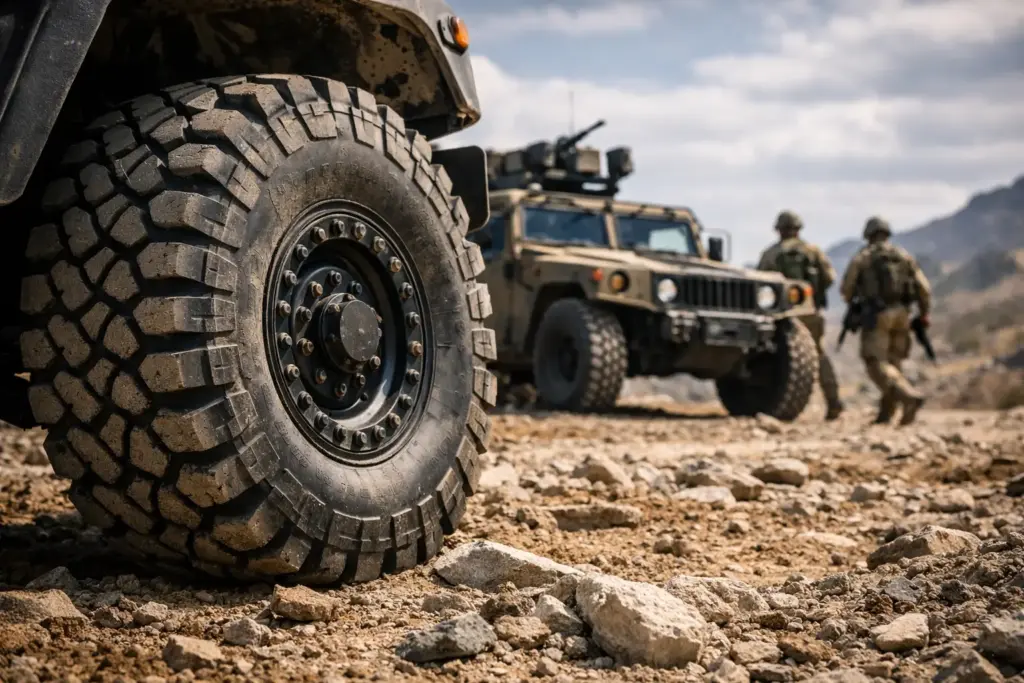
A Goodyear military tire review starts with a different question than a standard tire review: what machine is it going on, what load will it carry, and how far from pavement does it need to work? These tires were built around service requirements, not quiet highway manners or fuel economy. For the right truck, trailer, equipment platform, or restoration project, that can make surplus Goodyear military tires a practical buy. For the wrong application, it can create expensive fitment and ride problems.
Goodyear has supplied military-spec tires across a range of vehicle classes, from tactical trucks and trailers to utility platforms and specialized equipment. The brand name matters, but the specific casing, size, tread pattern, age, condition, and wheel compatibility matter more. Military inventory is not one uniform product line. Buyers should treat each tire as a technical item with its own intended use.
What Goodyear Military Tires Are Built to Do
Military tires are generally designed for carrying weight, resisting damage, and maintaining traction on poor surfaces. That usually means a heavier construction than a comparable consumer tire, deeper or more open tread, strong sidewalls, and a load rating suited to a specific vehicle configuration.
A Goodyear military tire may be a highway-oriented all-position design, an aggressive non-directional traction tire, a mud-focused pattern, or a specialty tire made for a particular axle and vehicle. The common thread is duty cycle. These tires expect rough roads, gravel, ruts, debris, extended idle periods, and loads that would quickly wear out light-duty tires.
That design focus comes with trade-offs. Thick casing construction can add substantial weight. Aggressive lugs can be loud on pavement and may wear unevenly if alignment, inflation, or axle setup is wrong. A military tire that performs well on a loaded 6×6 truck may feel harsh and unnecessary on a lightly used pickup.
Goodyear Military Tire Review: Strengths in Real Work
The biggest advantage is durability under load. Many Goodyear military tires use reinforced casings and sidewall construction intended to handle difficult terrain, heavy equipment, and sustained operational use. For commercial operators, contractors, and collectors running genuine military vehicles, this is often the feature that matters most.
Tread design is another strong point. Military traction patterns tend to clear loose material better than conventional highway tires. On forest roads, wet fields, job sites, gravel pits, and unimproved access routes, the open tread blocks and lug spacing can provide useful forward bite. They are not a substitute for chains or tracked equipment in severe conditions, but they are built for surfaces where a standard commercial rib tire will struggle.
Availability also has value. Certain military sizes are difficult to source through ordinary tire channels, especially older split-rim, multi-piece wheel, or tactical-truck fitments. Surplus inventory can give buyers access to recognizable Goodyear products in sizes and tread types that are no longer easy to order new. That matters when replacing one damaged tire on an existing vehicle, maintaining a fleet of specialized equipment, or completing a period-correct restoration.
Some military-spec Goodyear tires are also well suited to low-speed, high-load applications. Farm service vehicles, off-road trailers, industrial yards, and utility platforms can benefit from a tire designed to tolerate abuse instead of chasing a smooth highway ride.
The Limits: Where Buyers Need to Be Careful
A military designation does not automatically mean a tire is the best tire for civilian use. The tire may be excellent, but only when its specifications match the vehicle and operating conditions.
First, confirm the actual size. Military sizes are often expressed differently from modern passenger and light-truck sizes. A designation such as 11.00R20, 14.00R20, or 37×12.5R16.5 may require a specific wheel width, bead seat, and overall clearance. Do not assume a tire will fit because the diameter looks close. Check the wheel specification, section width, inflated diameter, dual spacing where applicable, and fender or steering clearance.
Second, verify the wheel system. Some military tires are meant for military-style beadlock wheels, two-piece or multi-piece assemblies, or wheels designed around run-flat components. Tire and wheel combinations are not interchangeable by appearance alone. Improper mounting can damage the tire, compromise bead retention, or create a serious safety risk. Multi-piece wheel work belongs with a qualified tire professional using the correct equipment and procedures.
Third, consider road use. A tire can have deep tread and still be a poor choice for frequent highway travel. Its speed capability, heat performance, noise level, handling, and wet-pavement behavior may not suit a daily-driven vehicle. Check applicable DOT markings, local road-use requirements, and the tire’s condition before planning highway miles. For off-road or limited-use equipment, the equation is different.
New Old Stock vs. Used Surplus
Condition is the main value question in surplus military tires. New old stock can offer unused tread and original casing integrity, but it may have spent years in storage. Used inventory may cost less and still have usable tread, but buyers need a clear condition assessment before purchasing.
For new old stock, inspect the date code, storage history when available, sidewall condition, bead area, and signs of dry cracking. Age alone does not tell the whole story. A tire stored indoors, out of direct sunlight and away from damaging chemicals, can be in far better shape than a younger tire left exposed to weather. Still, age should affect both price and intended use, especially for a tire going on a road-driven vehicle.
For used tires, look beyond tread depth. Ask about repairs, exposed cords, sidewall cuts, irregular wear, bead damage, flat spots, weather checking, and previous use. A tire with plenty of remaining tread can still be a poor purchase if the casing has been compromised. On the other hand, a sound used casing with even wear may be a cost-effective option for an off-road truck, trailer, equipment carrier, or restoration project.
When buying a matching set, compare date codes and condition across all tires. Mixing significantly different tread depths or diameters can cause problems on driven axles and is particularly important on vehicles with locking differentials, tandem axles, or all-wheel-drive systems.
Bias-Ply and Radial Construction Change the Decision
Not every Goodyear military tire is radial. Many older military and specialty tires are bias-ply, and that affects ride, handling, repair practices, and vehicle behavior.
Bias-ply tires are valued for tough sidewalls and a casing that can tolerate demanding low-speed off-road service. They can be a sensible choice for historic military vehicles, slow-moving equipment, and applications where sidewall protection is the priority. Their drawbacks are a firmer ride, more heat generation at speed, and less refined road behavior than a comparable radial.
Radial military tires generally offer better heat control, road manners, and tread life for mixed-use work. They are often the better option for commercial trucks and equipment that travel meaningful distances on pavement. Do not mix radial and bias-ply construction on the same axle unless the vehicle manufacturer and tire professional confirm that configuration is appropriate.
Buying by Application, Not by Appearance
The right tire depends on the work. A military vehicle collector may prioritize correct size, original-style tread, and wheel compatibility. A contractor may prioritize casing condition, load capacity, and replacement availability. An off-road user may want aggressive traction but must still account for steering feel, road noise, and the weight of a larger tire. A reseller or wholesale buyer needs consistent quantity, condition, and specifications across the lot.
Before buying, have the tire size, wheel size, required load rating, intended axle position, and operating surface written down. Also know whether you need tube-type or tubeless construction and whether the wheel uses a run-flat insert. Those details eliminate most costly mistakes before a tire ever reaches the shop.
MilitaryTires.ca carries specialized surplus tire and wheel inventory for buyers who need uncommon sizes, commercial-grade construction, and military applications that regular tire stores may not stock. Inventory condition and availability can change quickly, so compare the actual listing specifications rather than relying on a broad brand assumption.
Verdict: Strong Value When the Fitment Is Right
Goodyear military tires earn their reputation through heavy-duty construction, practical traction, and availability in specialized formats. They are a strong option for tactical vehicles, off-road work trucks, industrial equipment, farm use, trailers, and collectors who need the correct military fitment. They are not automatically the best choice for a light-duty street vehicle or high-speed daily use.
The smart purchase is not simply the deepest-tread tire or the lowest-priced surplus lot. It is the tire with the right casing condition, load rating, wheel compatibility, and tread design for the work ahead. Confirm those details first, and a Goodyear military tire can be a hard-working solution rather than a hard lesson.


 20x10 Beadlock 10 bolt Wheels/ 4000 axle series
1 × $340.00
20x10 Beadlock 10 bolt Wheels/ 4000 axle series
1 × $340.00 
 Accuride 17.5×6.75 Dual trailer wheel
1 × $99.00
Accuride 17.5×6.75 Dual trailer wheel
1 × $99.00  10R22.5 Major brand on wheel 5 ton truck
1 × $100.00
10R22.5 Major brand on wheel 5 ton truck
1 × $100.00  Dexter 17.5x6.75 wheel
1 × $95.00
Dexter 17.5x6.75 wheel
1 × $95.00 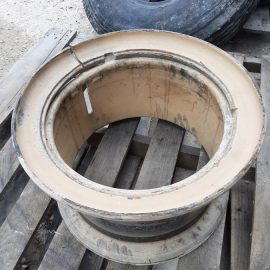 15x7.50 Dayton Wheel
1 × $85.00
15x7.50 Dayton Wheel
1 × $85.00  225/70R19.5 Goodyear G647 RSS
1 × $185.00
225/70R19.5 Goodyear G647 RSS
1 × $185.00