

Uncategorized
Guide to Agricultural Wheel Fitment for Farm Gear
Oct
A wheel that almost fits is not a bargain. On a tractor, sprayer, implement, or loader, a small mismatch in bolt circle, offset, center bore, or rim width can create steering interference, tire sidewall damage, broken studs, and expensive downtime. This guide to agricultural wheel fitment covers the measurements and application checks that need to happen before you buy a replacement wheel, a takeoff set, or surplus inventory.
Agricultural equipment often stays in service for decades. That is good for the farm, but it can make replacement wheels harder to source when the original part number is gone or the machine has already been modified. The right answer is not simply finding a wheel with the same tire diameter. Fitment starts at the hub and works outward.
Start With the Machine, Not the Tire
Record the machine make, model, axle position, and intended use before comparing wheel listings. A front wheel on a mechanical-front-wheel-drive tractor is not interchangeable with a rear wheel simply because the bolt pattern matches. Front-to-rear rolling circumference must stay within the tractor manufacturer’s allowable lead-lag range. Changing only one axle can put excess strain on the drivetrain.
Also identify whether the wheel is for a tractor, combine, planter, sprayer, wagon, skid steer, implement, or trailer. These applications can use similar-looking rims with very different load, speed, and offset requirements. A low-speed implement wheel may be unsuitable for a road-going grain cart. Likewise, a flotation tire and wheel package may clear field residue well but may not fit beneath existing fenders.
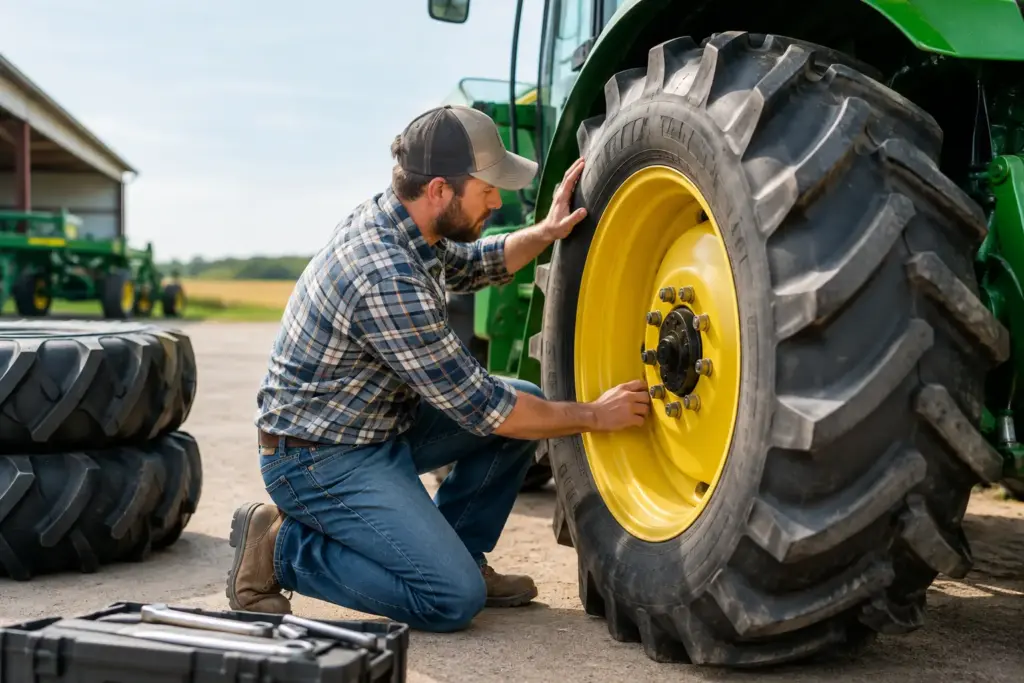
If the equipment has a current wheel installed, use it as the primary reference. Photograph both sides, record stamped markings, and measure it before removal if possible. Part numbers are useful, but dimensions decide whether a replacement can be safely mounted.
Agricultural Wheel Fitment: The Measurements That Matter
The critical dimensions are the wheel diameter and width, bolt pattern, center bore, offset or backspacing, pilot style, and load capacity. Do not assume a listed size provides all of this information.
Rim diameter and rim width
A tire size identifies the rim diameter, but it does not automatically confirm the correct rim width. For example, a tire intended for a 24-inch wheel still needs a rim width within the tire manufacturer’s approved range. Mounting a tire on a rim that is too narrow pinches the casing and changes the tread profile. A rim that is too wide can expose the sidewall, reduce bead retention, and affect field performance.
Measure diameter at the bead seat, not across the outside lip of the rim. Wheel width is measured between bead seats as well. Outside-to-outside measurements can add roughly an inch or more and lead to a wrong order.
For duals, track spacing deserves the same attention. A correct individual wheel can still create crop-row problems or sidewall contact when paired with the existing inner wheel.
Bolt pattern and bolt circle diameter
Count the studs or bolt holes first. Then measure the bolt circle diameter, commonly called BCD or PCD. On an even-numbered pattern, measure from the center of one stud directly across to the center of the opposite stud. On an odd-numbered pattern, the measurement method is different, so use a bolt-circle gauge or a verified chart rather than guessing.
A five-hole wheel with the wrong circle diameter may appear to line up on a few studs but will not seat correctly. Never force a wheel onto studs, enlarge holes to make a pattern work, or run mismatched lug hardware. Wheel studs are designed to clamp the wheel at the intended location, not correct an incorrect pattern.
Check whether the wheel uses studs and nuts, wheel bolts, clamps, or a disc-style mounting system. Many agricultural rear wheels use adjustable centers, power-adjust rims, loop rims, or clamp arrangements that are not comparable to standard automotive wheels.
Center bore, hub pilot, and stud pilot
The center bore is the opening at the middle of the wheel. On hub-piloted wheels, it centers the wheel on a machined hub surface and carries part of the location load. The bore must be large enough to clear the hub, but excessive clearance may prevent proper centering if the design depends on hub piloting.
Stud-piloted designs center through the lug hardware instead. Even then, the center hole needs adequate hub clearance. Dirt, rust scale, old paint, or a burr on the hub can stop a wheel from sitting flat. Clean the mounting faces before test fitting, and verify that the wheel fully contacts the hub or mounting disc.
Offset, backspacing, and track width
Offset is the distance between the wheel centerline and the mounting face. Backspacing measures from the mounting face to the inside rim edge. Both affect where the tire sits relative to steering arms, brakes, axle housings, fenders, loader frames, and row crops.
Positive offset pulls the wheel farther inward. Negative offset pushes it outward. Either can be useful, depending on the machine, but it changes leverage on bearings and changes overall track width. On steering axles, a change in offset can cause tire rub at full lock even when the wheel bolts on cleanly.
Measure existing backspacing and compare it with the replacement wheel. Then check physical clearance with the tire size you plan to run. A wider tire, deeper lug, or larger section width can turn an acceptable wheel offset into an interference problem.
Match Wheel Capacity to the Real Working Load
Agricultural wheels are load-carrying components. The right rim must handle the loaded tire, machine weight, ballast, implements, and operating speed. This matters most on sprayers, loaders, combines, manure equipment, and tractors carrying front-end attachments.
Do not use tire load capacity as proof that the wheel is adequate. The wheel itself has a rating, and that rating may be lower than the tire’s capability. Used and new old stock wheels can offer real value, especially for older equipment, but inspect condition closely. Look for cracked welds, elongated bolt holes, severe corrosion around the bead area, bent flanges, repairs, and evidence of prior tire slip.
Calcium chloride ballast deserves extra caution. A wheel may look serviceable from the outside while corrosion has weakened the rim around the valve stem or bead seat. If there is heavy scaling, rust-through, or uncertain structural damage, replace it rather than trying to stretch another season out of it.
Verify Tire Type, Valve Setup, and Clearance
The wheel needs the correct bead profile for the tire type. Tubeless agricultural tires require a rim designed to seal tubeless beads. Tube-type assemblies need compatible components and careful inspection of the inside rim surface. A damaged or poorly fitted valve hole can create a slow leak that becomes a field failure.
For liquid ballast, use the proper valve orientation and compatible valve hardware. For high-clearance sprayers or row-crop tractors, check not only tire-to-fender clearance but clearance at articulation points, steering lock, and full suspension travel where applicable.
Radial and bias agricultural tires also behave differently under load. A radial may have greater sidewall flex and a broader footprint, which can affect clearance compared with an older bias-ply tire of a similar labeled size. Confirm the manufacturer’s approved rim-width range instead of relying on what another machine happens to use.
A Practical Pre-Order Check
Before ordering, compare the replacement wheel against your current assembly using the same units. Have these details ready: machine application, axle position, tire size, rim diameter and bead-seat width, bolt-hole count, bolt circle, center bore, offset or backspacing, pilot type, and required load rating. If you are replacing only one wheel, include photos of the mounting face and hub.
For used wheels, ask about visible repairs, condition of the bead seats, bolt-hole wear, and whether the wheel is sold individually or as a matched set. Surplus inventory is often the best route to uncommon agricultural sizes, but surplus means confirming the actual specifications rather than assuming an old stock number fits every version of a machine.
MilitaryTires.ca carries specialized wheel and tire inventory that can help when conventional farm-tire channels do not have the size or configuration you need. Whether you are buying one replacement rim or sourcing multiples for a fleet, verify measurements before freight is arranged. Agricultural wheels are heavy, shipping is expensive, and a correct fitment check is cheaper than a return.
When the numbers match, do one final dry fit before mounting a tire. Make sure the wheel seats flat, hardware engages correctly, and the tire will clear through the full range of steering and axle movement. That short check is what turns a hard-to-find wheel into a working repair instead of another part sitting in the shop.
