

Uncategorized
Radial vs Bias Farm Tires for Your Operation
Aug
A rear tractor tire that slips under load, packs mud in the tread, or pounds the operator across a rough field costs more than its purchase price. The radial vs bias farm tires decision affects traction, fuel use, soil compaction, ride quality, downtime, and how well the tire stands up to the work your equipment actually does.
There is no automatic winner. Radials are often the better choice for field efficiency and frequent road travel. Bias tires still make sense for demanding loader work, rough ground, lower-hour equipment, and buyers who need a tough tire at a lower upfront cost. Start with the machine, the load, the surface, and the required size and load rating – not the tire style alone.
Radial vs Bias Farm Tires: The Construction Difference
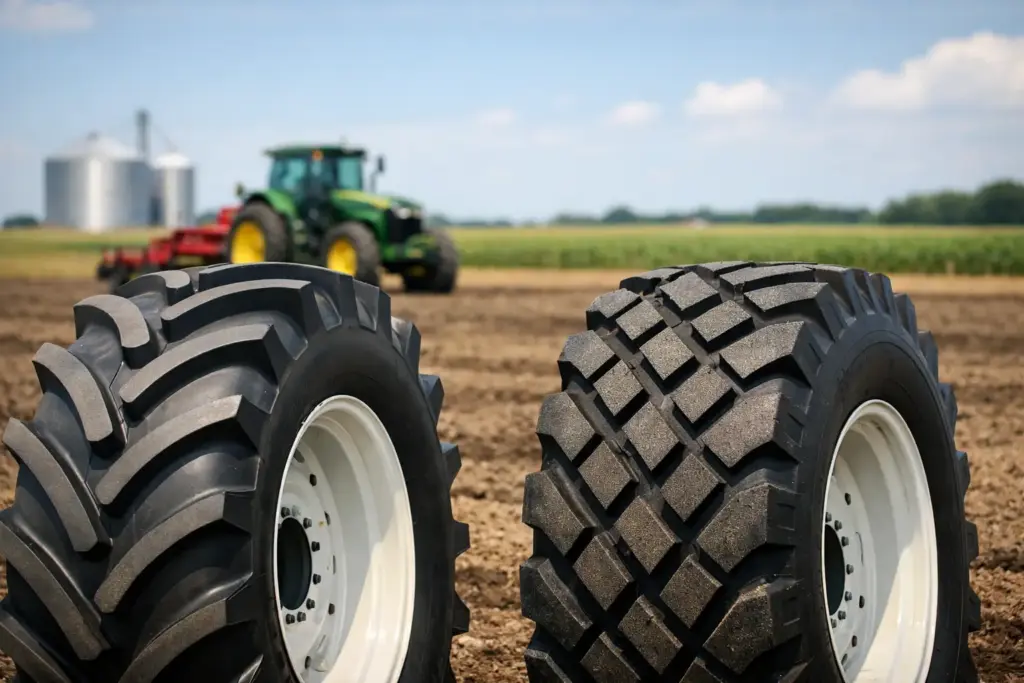
A bias-ply tire is built with body plies that run diagonally from bead to bead. The plies overlap in a crisscross pattern, tying the sidewall and tread area together. This creates a firm, durable carcass with strong resistance to sidewall damage, but it also means the whole tire flexes as one unit.
A radial tire uses body plies that run straight across the tire from bead to bead, with belts beneath the tread. Its sidewalls can flex more independently from the tread face. That lets the tread maintain a larger, flatter contact patch at the ground while the sidewall absorbs movement.
For the buyer, the construction difference shows up in the field. Radials generally put more tread on the soil at the correct pressure. Bias tires generally have a stiffer feel and a more rigid sidewall. Neither construction excuses incorrect inflation, overloaded equipment, poor wheel condition, or a mismatch between tire size and application.
Where Radial Farm Tires Earn Their Keep
Radial farm tires are commonly selected for tractors, sprayers, combines, and other equipment that spends long hours covering acres. Their main advantage is efficient footprint management. With proper inflation for the actual axle load, a radial can spread that load across a broader contact area than a comparable bias tire.
That larger footprint can improve pull in loose soil and reduce wheel slip. Less slip can mean fewer wasted passes, lower fuel consumption, and less rutting when conditions are right. It can also help protect soil structure, especially on ground where compaction is already a concern.
Ride quality is another practical benefit. Radial sidewalls flex more readily, which helps smooth out field travel and road runs. For operators moving between farms, hauling implements, or logging significant road hours, that reduction in vibration is more than a comfort feature. It can reduce fatigue and lessen shock transferred through equipment.
Radials also tend to wear more evenly during road use when they are correctly matched, inflated, and aligned. That matters for tractors and self-propelled equipment that see both field and pavement. The trade-off is purchase price. Radials usually cost more upfront, and their flexible sidewalls can be more vulnerable when operated against sharp stubble, rocks, debris, or obstacles at low pressure.
When Bias Farm Tires Are the Better Buy
Bias tires remain a working choice, not an outdated one. Their firmer carcass and sidewall structure suit equipment that sees rough yards, wooded ground, rocky lanes, feedlots, construction-adjacent work, and frequent loader use. A stiff bias sidewall can handle side loading and repeated contact with obstacles better in many of these situations.
They are also often a sensible fit for older tractors, implements, wagons, and lower-hour machines where the price premium of a radial may not pay back quickly. If a tractor works a few weekends a year, pulls a mower, moves hay, or handles general property work, a quality bias tire may deliver the service life required without tying up extra capital.
Bias construction can be particularly attractive when a buyer needs an uncommon size, an older fitment, or a cost-effective replacement for a machine being repaired for resale. New old stock, takeoffs, and surplus inventory can create value in these applications, provided the tire’s age, storage history, casing condition, and compatibility are checked before purchase.
The compromise is that bias tires usually run with a smaller footprint and a stiffer ride. In soft ground, they may show more slip and can concentrate load more heavily than a radial at an equivalent application. That does not make them unsuitable for field work. It means buyers should be realistic about the acres, loads, speed, and soil conditions involved.
Match the Tire to the Job, Not Just the Tractor
A tire can be the correct nominal size and still be the wrong purchase. Before choosing radial or bias construction, verify these operating details:
- Axle load and implements: Loader work, mounted implements, front weights, liquid ballast, duals, and heavy trailers all change the required load capacity and inflation pressure.
- Primary surface: Soft tilled ground, pasture, hardpack, gravel, pavement, rock, and mud each favor different tread patterns and carcass characteristics.
- Travel speed and road time: Equipment that regularly runs roads at speed needs a tire approved for the intended speed and load, not just a matching diameter.
- Clearance and wheel fitment: Confirm rim width, bolt pattern where applicable, overall diameter, section width, fender clearance, and front-to-rear rolling circumference on MFWD and four-wheel-drive tractors.
On mechanical front-wheel-drive tractors, correct rolling circumference is critical. A front tire that is too tall or too short relative to the rear can create drivetrain bind, accelerated wear, and poor pulling performance. Do not assume a different tire brand or a newer radial designation has the same loaded rolling radius as the tire it replaces.
Ply rating also needs context. It is a load-range indicator, not a direct count of physical plies in every modern tire. Compare the manufacturer load table, speed rating, and recommended inflation range for the exact tire size. A higher ply rating may provide needed capacity, but overinflating an unloaded tire just to make it feel firm can reduce its footprint and ride quality.
Inflation Is Part of the Tire Decision
Many farm tire problems begin after the tire is mounted. Radials are especially sensitive to inflation because their performance depends on controlled sidewall flex. Too much pressure reduces the contact patch and gives away traction and flotation benefits. Too little pressure can build heat, damage the casing, and risk bead issues under heavy loads or road speed.
Set pressure based on the heaviest expected axle load and the fastest expected travel condition, using the tire manufacturer’s load and inflation data. Recheck it when ballast, implements, loader use, or seasonal work changes. A tractor set up for light tillage may need different pressure than the same tractor carrying a heavy mounted planter or a fully loaded front loader.
Bias tires also need accurate pressure. Their stiffer construction may hide underinflation longer, but that does not eliminate heat buildup, casing stress, or irregular wear. Use a reliable gauge, inspect for cuts and sidewall damage, and check valve stems, wheels, and bead areas during regular service.
Buying Surplus, Used, or Takeoff Farm Tires
Specialized inventory can be a practical way to source hard-to-find farm tires, especially for older equipment or a mixed fleet. Condition matters as much as construction. A used tire with strong tread but sidewall cracking, exposed cords, bead damage, uneven wear, or repairs in critical areas may not be the value it first appears to be.
For new old stock, inspect date codes and storage condition. Tires stored indoors, out of direct sunlight, away from ozone sources, and protected from moisture generally hold up better than tires left outdoors for years. For takeoffs, ask about the prior application, whether the tire was run with liquid ballast, and whether it was removed due to normal replacement, damage, or a machine sale.
MilitaryTires.ca buyers should also confirm whether the listed price is per tire or per set, whether a matching mate is available, and whether freight handling is practical for the tire’s size. Large agricultural tires are not standard parcel shipments. Plan for delivery access, unloading equipment, and local mounting support before the truck arrives.
A radial is usually worth the added cost when field acreage, fuel use, soil protection, and road travel are major operating factors. A bias tire is often the right call when sidewall toughness, rough-ground service, equipment age, or initial cost carries more weight. Choose the construction that fits the work cycle, then protect that investment with correct fitment and inflation.
