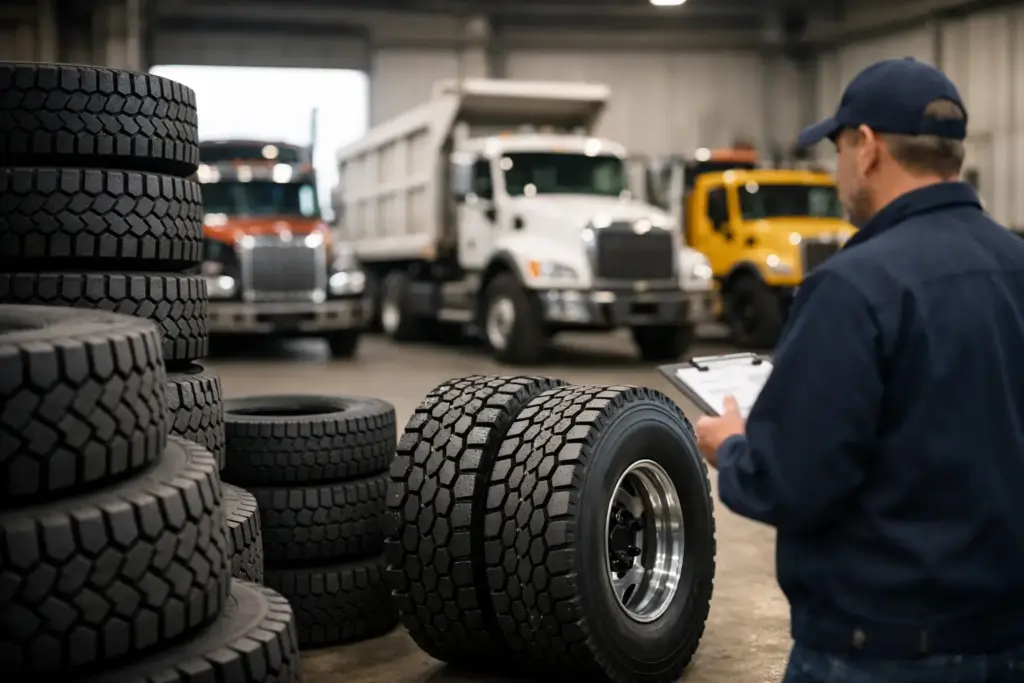
A truck down for one hard-to-find tire can cost more than the price difference on an entire order. That is why bulk tire purchasing is not just a volume discount conversation. For fleets, contractors, farms, resellers, and off-road operators, it is a way to control downtime, standardize equipment, and secure inventory before a specific size or tread disappears.
The right bulk order starts with the work, not the sale price. A military takeoff that is ideal for a restoration project may be the wrong choice for a long-haul commercial route. A low-hour used OTR tire may be excellent value for a loader working on private property, while a fleet covering highway miles may need matching new old stock tires with clear date codes and consistent wear characteristics. Buy for the application first. Then negotiate quantity, condition, freight, and delivery timing.
What Bulk Tire Purchasing Should Accomplish
A serious bulk order should solve an operating problem. It may reduce the unit cost of replacement tires, but the bigger advantage is having matching inventory on hand when equipment needs it. Specialty sizes are not always available on short notice, especially military-spec, agricultural, industrial, aircraft, flotation, and off-road tires.
For a fleet manager, bulk purchasing can support a planned replacement cycle. For a tire reseller, it can create margin on inventory that mainstream distributors do not carry. For a contractor or farmer, it can mean buying a full set plus spares before seasonal work begins. The benefit changes by buyer, but the objective stays the same: avoid paying premium prices under pressure.
Matching inventory also matters. Running one different tread pattern, casing type, or outside diameter in a four-wheel-drive application can create handling issues, drivetrain stress, or uneven wear. On commercial equipment, mixed tires can complicate maintenance and make rotation planning harder. Bulk buying gives you a better chance of keeping like tires together.
Start With a Real Equipment List
Do not begin with a tire size alone. Build an equipment list that identifies the exact requirement for every vehicle, trailer, implement, or machine. Record the current tire size, wheel size, load range or ply rating, speed requirement, tread type, valve configuration where relevant, and whether the tire is tube-type or tubeless.
For off-road and agricultural equipment, include the tire’s overall diameter, section width, rim width range, and clearance limits. A tire that technically fits the rim may still rub steering components, fenders, suspension parts, or dual-wheel hardware. On military vehicles and older industrial equipment, confirm the original wheel pattern and bead seat design before purchasing tires or complete wheel assemblies.
Commercial buyers should also identify the axle position. Steer, drive, trailer, and all-position tires are built for different service demands. A deep lug drive tire can deliver traction in mud, gravel, or jobsite work, but it may not be the right answer for a trailer running mostly paved miles. The lowest per-tire price is not a bargain if it causes premature wear in the wrong position.
New, New Old Stock, Used, and Takeoff Inventory
Condition is one of the main reasons specialty tire buyers can find value in volume. It is also where assumptions get expensive.
New tires are the straightforward option when current production, manufacturer support, and maximum service life are the priority. New old stock can offer major value when the tire has been stored correctly and the specification fits your equipment. Check date codes, storage history when available, sidewall condition, and whether the tires have been protected from direct sunlight, moisture, and ozone exposure. Age alone does not tell the full story, but it should be part of the buying decision.
Used inventory and takeoffs can make sense for low-mileage, seasonal, off-road, restoration, or secondary equipment. Buyers should ask for usable tread depth, photos of the bead areas and sidewalls, repair history if known, and confirmation of any visible cuts, cracking, punctures, or irregular wear. When purchasing multiple used tires, request units with similar tread depth and construction whenever possible.
There is no universal rule that new is always better or used is always cheaper in the long run. A used tire with heavy remaining tread may be the practical choice for a machine that runs a few hundred hours per year. A road fleet with strict uptime and compliance requirements may be better served by new matched tires, even at a higher initial cost.
Price the Full Landed Cost, Not Just the Tire
A pallet of large tires can look inexpensive until freight, cross-border paperwork, unloading, and local handling are added. Bulk tire purchasing needs a landed-cost calculation before the order is placed.
Start with the tire price, then account for freight to your location, taxes where applicable, brokerage or customs considerations for cross-border shipments, and the equipment required to unload the shipment. Large commercial, OTR, aircraft, and farm tires may require a forklift, loader, dock access, or a jobsite delivery plan. If delivery arrives at a location without the right equipment, a good purchase can turn into a costly delay.
Calculate cost per usable tire, not simply cost per tire purchased. If an order includes mismatched condition, unusable casings, or sizes you cannot move, the apparent discount disappears. Resellers should also account for storage, inspection labor, mounting support, and the time required to sell slower-moving sizes.
For buyers in the United States sourcing specialized inventory from Canada, confirm shipping details before committing. Tire dimensions, total weight, destination access, and border requirements all affect the final number. Clear freight planning is especially important for partial truckloads and oversized products.
Buy Enough for Continuity, Not So Much That It Sits
The right quantity depends on consumption rate, storage capacity, and how difficult the tire is to replace. A highway fleet using common sizes may only need a modest buffer. A collector, mining operation, airport service provider, or owner of older military equipment may need to buy deeper because replacements are irregular and inventory can move quickly.
Use your maintenance records to estimate annual demand. Look at tire failures, planned replacements, seasonal peaks, and the lead time you have experienced in the past. Then decide whether the order is meant to cover one replacement cycle, one operating season, or a longer reserve.
Storage is the limiting factor for many bulk buyers. Tires should be kept clean, dry, and away from direct sunlight, electric motors, welding areas, fuel spills, solvents, and standing water. Keep inventory organized by size, condition, date code, and intended application. If you cannot identify what is on the rack, you cannot use the inventory when a machine is down.
When Auctions Make Sense for Bulk Buyers
No-reserve auctions can be a strong buying channel when the buyer understands the product and has flexibility on brand, tread pattern, or exact quantity. They are especially useful for tire resellers, restoration shops, and operators looking for surplus lots, wheels, takeoffs, or uncommon military sizes.
Auction buying is less suitable when a fleet needs an exact tire specification by a fixed date. In that case, buy-now inventory may be the better choice because it provides clearer availability and a more predictable order process. The best approach is often mixed: secure critical replacement stock directly, then use auctions to build non-critical inventory when the right lots appear.
Before bidding on a bulk lot, confirm quantity, condition, dimensions, pickup or shipping requirements, and whether all tires are the same size and construction. A mixed lot can be valuable, but only if you have equipment that can use it or customers who will buy it.
Work With a Supplier That Understands Specialty Inventory
Generic tire buying programs are built around common passenger and light-truck demand. They may not be equipped to source 16.00R20 military tires, flotation farm tires, heavy OTR casings, aircraft tires, or specialized wheel assemblies in quantity. Specialty inventory requires accurate descriptions, condition transparency, and staff who understand fitment beyond a basic size lookup.
MilitaryTires.ca supports buyers looking for surplus, military, industrial, agricultural, commercial, and hard-to-find tire inventory across the United States and Canada. For bulk orders, provide the full specification, quantity needed, delivery location, and whether new, new old stock, used, or takeoff condition is acceptable. That gives the supplier room to identify inventory that actually fits the job.
A good bulk order is not the one with the biggest discount on paper. It is the one that arrives in usable condition, fits the equipment, can be stored properly, and keeps your operation from waiting on a tire when the work is already scheduled.


 20x10 Steel Beadlock Wheel
1 × $245.00
20x10 Steel Beadlock Wheel
1 × $245.00 
 14.00R20 Michelin XL
1 × $400.00
14.00R20 Michelin XL
1 × $400.00  14.00-20 General
1 × $425.00
14.00-20 General
1 × $425.00