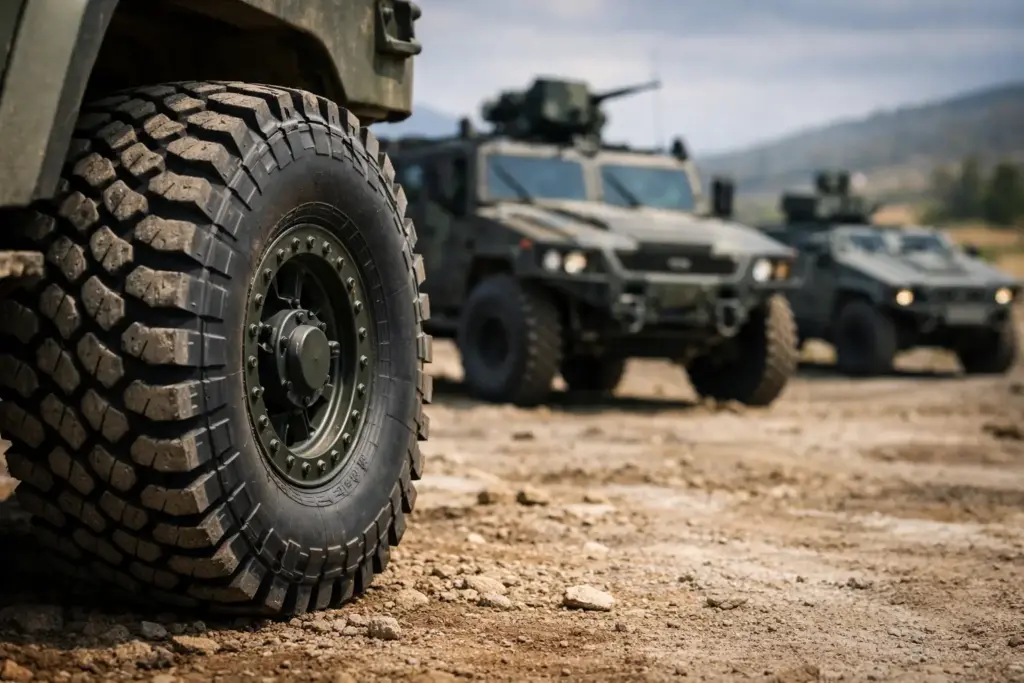
A set of top military vehicle tires is not defined by aggressive tread alone. The right tire has to match the vehicle’s wheel, axle load, operating surface, speed requirements, and intended use. A tire that works on a decommissioned tactical truck may be a poor choice for a collector vehicle that sees regular pavement miles. Likewise, a highway-capable military tire may not be the best fit for mud, forestry work, sand, or low-speed industrial use.
Buyers looking at military-spec inventory usually need one thing: a hard-to-find tire or wheel combination that can carry real weight and hold up outside normal consumer use. That means fitment comes first. Brand, condition, tread pattern, and price come after the basic numbers are correct.
What Makes Top Military Vehicle Tires Different?
Military vehicle tires are built for applications where payload, rough terrain, puncture resistance, and mobility matter more than ride comfort. Many use heavy-duty carcasses, deep non-directional tread, reinforced sidewalls, and high load capacities. Some are designed to operate with central tire inflation systems, beadlock wheels, or run-flat inserts.
That does not mean every military tire is suitable for every off-road build. Large military tires can be heavy, loud on pavement, difficult to mount, and expensive to ship. Their tread may wear quickly during highway use, especially on lighter vehicles. A buyer converting a military truck for road use should consider road speed, local tire regulations, steering feel, braking distance, and whether the tire has a current DOT date code where required.
The practical advantage is access to sizes and constructions that are uncommon in standard retail channels. Examples include 11R20, 14.00R20, 16.00R20, 395/85R20, 445/65R22.5, and other specialty flotation or tactical sizes. These tires are often needed for military restorations, expedition rigs, logging equipment, agricultural equipment, trailers, and commercial conversions.
Top Military Vehicle Tires Start With the Application
The best tire category depends on where the vehicle works. A M35, M809, LMTV, HMMWV, Unimog, or tactical trailer can all require different sizes, wheel systems, and load ratings. Do not buy based on appearance alone.
Off-road and mixed-terrain work
For logging roads, field access, construction sites, trails, and utility work, look for an all-terrain or non-directional traction tread. These designs typically have open shoulder blocks and a deep void pattern that sheds mud better than a highway tire. They also provide useful traction on loose gravel and uneven ground.
The trade-off is road behavior. Open-lug tires generally produce more noise, may wander on grooved pavement, and can wear unevenly if alignment, inflation, or suspension components are not right. If the truck spends most of its time on pavement, a commercial traction tire or military all-position pattern may be the smarter operating-cost choice.
Soft ground, mud, and sand
Mud and sand demand different things. Deep mud calls for void space and self-cleaning lugs. Sand often benefits from flotation, a larger footprint, and carefully managed tire pressure. A tire with extremely aggressive lugs can dig too quickly in loose sand, while a flotation-style tire may not clear heavy mud well.
Vehicles equipped with central tire inflation systems have an advantage because pressure can be adjusted as terrain changes. Without CTIS, use only pressures appropriate for the tire, wheel, load, and operating conditions. Running low pressure without compatible wheels or sufficient load knowledge can damage beads, sidewalls, and tire casings.
Highway, fleet, and commercial use
For vehicles that travel between job sites or run loaded on paved roads, load capacity and heat management deserve more attention than tread depth alone. Verify the tire’s speed symbol, ply rating or load range, load-and-inflation table, and intended service position. A military surplus tire may be physically capable of carrying the weight but still be unsuitable for sustained highway speed.
Commercial operators should also consider replacement availability. Buying an uncommon size at a good auction price is only a good deal if replacement tires, tubes, flaps, wheels, and service support can be sourced later.
Fitment Checks Before You Buy Military Tires
Military tire fitment involves more than matching the sidewall size. Wheel design is especially important because many military vehicles use multi-piece wheels, beadlock systems, tube-type assemblies, or proprietary rim profiles. A tire may fit the diameter but not safely seat on the wheel you have.
Before purchasing, confirm these four points:
- Tire size and approved rim width, including whether the tire is tube-type or tubeless.
- Wheel diameter, bead seat type, bolt pattern, offset, and center bore where wheels are included.
- Required load capacity at the inflation pressure you can safely run.
- Overall diameter and section width, including clearance at full steering lock and suspension travel.
Overall diameter affects more than fender clearance. Larger tires change effective gearing, speedometer readings, braking behavior, and axle load. On older military trucks, tire diameter can also affect transfer case operation and drivetrain stress. Match tires across an axle, and do not mix substantially different rolling diameters on vehicles with driven front axles, locking differentials, or all-wheel-drive systems.
New Old Stock vs. Used Military Tires
Surplus buyers often have a choice between new old stock and used takeoffs. Neither is automatically the better purchase.
New old stock can offer unused tread and original military construction at a lower price than current-production specialty tires. However, age still matters. Inspect the DOT date code when present, storage history, sidewall condition, and any signs of ozone cracking, dry rot, flat spotting, or casing deterioration. A tire stored indoors and protected from weather is not the same as one that sat outside through years of temperature swings.
Used military tires can deliver strong value when tread depth is adequate and the casing is sound. They are often a practical option for a restoration project, farm trailer, slow-speed equipment, or off-road vehicle that does not need daily highway service. Inspect used inventory for repairs, irregular wear, bead damage, exposed cords, sidewall cuts, and matching tread patterns. When buying multiple tires, ask whether they are a matched set or individual units with varying wear and date codes.
Condition descriptions matter. “Used,” “takeoff,” and “surplus” are not performance ratings. They describe inventory status. The buyer still needs to assess fitment and service requirements.
Brands and Constructions Worth Looking For
Recognized manufacturers such as Michelin, Goodyear, Bridgestone, BFGoodrich, and Hutchinson have produced military and severe-service tires across many vehicle classes. The brand name is useful, but the exact model and construction matter more. A Michelin XZL-style all-terrain casing, a Goodyear military traction pattern, and a Hutchinson-compatible run-flat assembly solve different problems.
For heavy tactical trucks, prioritize load rating, casing condition, and wheel compatibility. For HMMWV and similar platforms, verify the specific 16.5-inch wheel configuration, run-flat requirement, and tire profile before ordering. For collector vehicles, original-style tread may matter most. For commercial or agricultural use, a tire with readily available service parts and replacement options can be worth more than a period-correct pattern.
Buy for the Job, Not the Photo
Military tires are specialized inventory, and specialized inventory moves. When the correct size, condition, and quantity appear, confirm the technical details before someone else buys the set. This is especially true for matching pairs, complete wheel-and-tire assemblies, and low-volume military sizes.
MilitaryTires.ca carries surplus, takeoff, new old stock, and specialty tire inventory for buyers who need uncommon fitments without wasting time sorting through consumer catalogs. For single-vehicle projects, fleets, resellers, and bulk purchasers, the practical approach is the same: verify the numbers, inspect the condition, and buy the tire that fits the work ahead.
A good military tire should make the vehicle more useful, not merely more imposing. Start with the load, wheel, terrain, and miles you expect to run, then let the tread pattern and price narrow the field.


 37x12.5R16.5 BFGoodrich Baja TA on aluminum Wheel
5 × $750.00
37x12.5R16.5 BFGoodrich Baja TA on aluminum Wheel
5 × $750.00 
 20x10 Accuride Beadlock Wheel
1 × $200.00
20x10 Accuride Beadlock Wheel
1 × $200.00  31X10X20 (10x16.5) Solid Tire and Wheel Press-on
1 × $200.00
31X10X20 (10x16.5) Solid Tire and Wheel Press-on
1 × $200.00  7.00-6 BFGoodrich aircraft tire on wheel
1 × $415.00
7.00-6 BFGoodrich aircraft tire on wheel
1 × $415.00