

Uncategorized
Off Road Tires for Sale: What to Check
May
A tire that looks aggressive in a photo can still be the wrong tire for your machine, your load, or the ground you run on. When buyers search for off road tires for sale, the real question is not just price – it is whether the tire will carry the weight, fit the rim, hold up in rough service, and stay available when they need replacements.
That matters even more in surplus and specialty inventory. A hard-to-find military takeoff, a new old stock mud tire, or an industrial off-road casing can offer real value, but only if the specs line up with the job. If you are buying for a farm truck, side-by-side, military project, skid steer, rock crawler, or contractor fleet, the details decide whether the purchase saves money or creates downtime.
How to shop off road tires for sale
Start with the application, not the tread pattern. Buyers often begin by looking for the most aggressive lug design they can find, but tread is only one part of the purchase. The machine type, axle weight, terrain, speed, and duty cycle should narrow the field before you compare prices.
A weekend trail rig can tolerate compromises that a work truck or utility vehicle cannot. If the machine runs loaded, sees mixed surfaces, or covers any paved distance, you need to pay close attention to casing strength, load capacity, and wear behavior. A deep mud tire might perform well in soft ground and still become a liability on gravel roads or hardpack if the lugs chunk or the ride turns unstable.
The best buying decisions usually come from matching the tire to the actual use case. Mud, rock, sand, logging roads, construction sites, and farm lanes all ask different things from a tire. There is no single off-road tire that wins in every condition.
Size comes first
Before brand, before condition, and before price, confirm size. That means the tire size itself, the rim diameter, section width, overall height, and whether the tire’s profile will clear suspension and body components under load or articulation. Buyers working with military surplus or older equipment should be especially careful here because sizing formats can vary across applications.
Some equipment owners are replacing a direct match. Others are trying to upgrade to a more aggressive tread or a taller tire. That can work, but only if the wheel width, gearing, braking, and clearance still make sense. A cheap tire that rubs, overloads the wheel, or changes performance in the wrong direction is not a value buy.
Load rating is not optional
This is where many listings get misread. An off-road tire can look heavy-duty and still be wrong for a loaded truck, trailer, or equipment platform. Load range, ply rating, and the actual load capacity need to match the machine and how it is used. For commercial buyers, this is a basic procurement issue. For hobby buyers, it is often the difference between a tire that lasts and one that fails early.
If the vehicle carries tools, payload, implements, or mounted equipment, leave room for real-world conditions. Rough terrain adds stress. Heat, impact, and sidewall flex all matter more off pavement. Buyers should not shop by appearance alone when the machine is doing actual work.
New, used, or new old stock
One of the biggest advantages in this segment is access to inventory outside standard retail channels. That includes used tires, military takeoffs, and new old stock. Each can make sense, but each should be evaluated differently.
Used off-road tires can offer strong value when the casing is sound, tread depth is still meaningful, and the application does not demand brand-new rubber. That can be a smart buy for project vehicles, utility trailers, seasonal equipment, or budget-conscious operators. The trade-off is simple – condition matters more than the label, and buyers need clear information on wear, repairs, weathering, and age.
New old stock can be attractive because it may provide hard-to-find sizes or premium brands at lower pricing than current production. But age still matters, even if the tire has never been mounted. Storage conditions, sidewall condition, and intended use all need review. For lower-speed or specialty applications, NOS inventory may be a practical answer. For high-speed or heavy-use service, buyers should look closer and ask harder questions.
Military takeoffs sit in their own category. They are often built for durability and load, and they can solve sourcing problems for military vehicle restorations, service rigs, trailers, and custom builds. They are not automatically the right answer for every buyer. Some ride harsher, weigh more, or behave differently on pavement than a conventional consumer off-road tire.
Tread design and terrain
A tire that performs well in deep mud may be noisy, vague, or fast-wearing on hard surfaces. A more moderate all-terrain pattern may give up some traction in soft ground but work better for mixed-use service. That trade-off is normal.
Mud-terrain tires are built for self-cleaning and forward bite. They suit deep ruts, wet ground, and loose soil, but they are not always the best option for vehicles that spend meaningful time on road or gravel. All-terrain patterns give more balanced behavior and may be the better commercial choice for pickups, service trucks, and equipment support vehicles that need off-road capability without the penalties of a full mud tire.
For industrial and agricultural users, the decision gets more specific. Lug spacing, sidewall shape, and contact patch all change how a tire performs in fields, yards, and job sites. A tire that works well on a trail vehicle may be completely wrong for a loader, telehandler, or utility machine. Buyers need to shop by application category, not just by the words off road.
What to inspect in a listing
When reviewing off road tires for sale, focus on the details that affect service life and fitment. Brand matters, but specs and condition matter more.
Look at the full size marking, load information, tread depth if available, and whether the tire is tube-type or tubeless. Check if it is sold as a single, pair, or full set. Confirm whether wheels are included, especially in surplus and auction inventory where assemblies may be listed together.
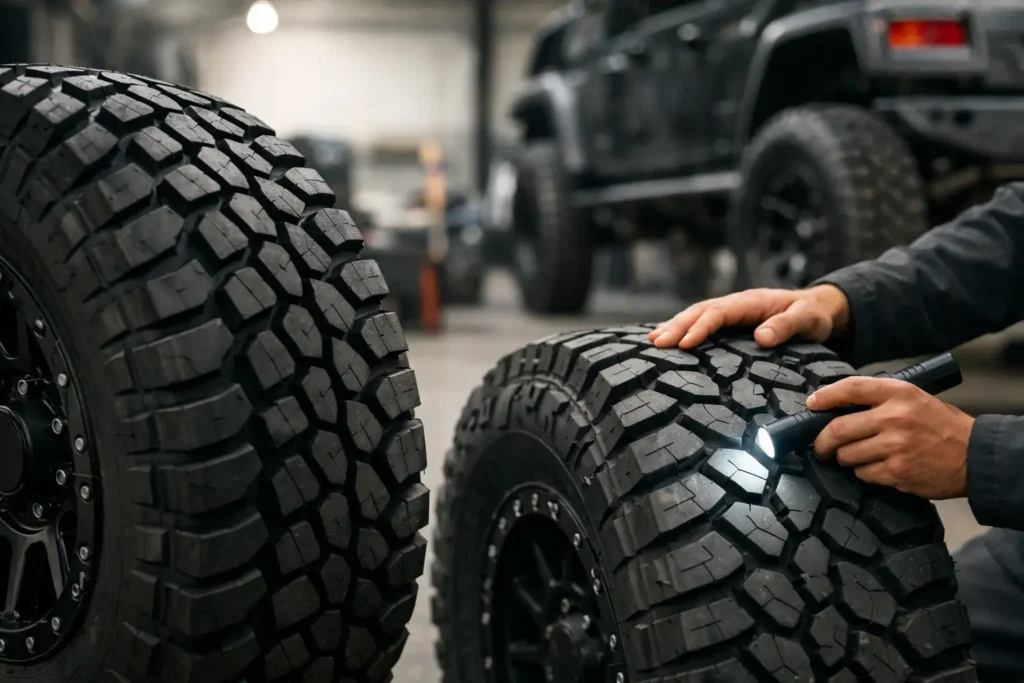
Photos should support the description. You want to see tread face, sidewalls, bead area, and any wear patterns that suggest alignment problems, flat spotting, cuts, or prior repairs. For used inventory, honest condition notes are a good sign. For NOS stock, signs of dry cracking or poor storage should be taken seriously.
Commercial and wholesale buyers should also think past the first purchase. Can the seller supply multiples in the same size and condition range? Is there enough inventory to support a fleet, resale channel, or repeat maintenance cycle? A low price on one tire does not help much if the second or third replacement is impossible to source.
Why specialty inventory matters
Mainstream tire sellers are set up for common sizes and current production lines. That works for standard replacement cycles, but it does not solve every problem. Buyers in agricultural, industrial, military, and utility sectors often need uncommon sizes, discontinued patterns, surplus wheels, or brand-specific stock that ordinary retail channels do not carry.
That is where specialized inventory has real value. A large surplus seller can give buyers access to tread types, wheel assemblies, military-spec options, and hard-to-find casings that would otherwise take weeks of calling around to locate. For resellers and procurement buyers, that access can be more important than polished storefront presentation.
MilitaryTires.ca fits that lane because the value is not just product listings – it is depth of stock across surplus, off-road, commercial, farm, and industrial categories, with shipping into both the US and Canada. For buyers who care about getting the right tire without wasting time, inventory breadth is part of the product.
Auction, clearance, or buy-now
Not every buyer shops the same way. Some need a tire today, at a known price, with no delay. Others are willing to watch auction inventory, buy in bulk, or sort through clearance stock to hit a better number.
Buy-now purchasing is the simplest route when uptime matters. You confirm fitment, pay, and move on. Auction and liquidation-style buying can produce stronger value, especially for resellers, project builds, and wholesale buyers, but it works best when you already know the acceptable size and spec range. The lower the price, the less room there usually is for guesswork.
For bulk buyers, consistency is the real issue. If the goal is stocking a yard, supporting customers, or keeping a fleet supplied, the best deal is often the one that balances unit cost with repeat availability.
Buying the right tire, not just a cheap one
Cheap off-road tires can become expensive fast when they wear out early, fail under load, or create handling problems. On the other hand, paying top retail for a tire that is overspecified for the job is not efficient either. The smart buy is the tire that fits the machine, matches the terrain, and gives you the service life the application actually requires.
That is why experienced buyers compare more than price tags. They look at load rating, condition, tread type, casing quality, and inventory depth. They also know when surplus inventory is an advantage and when it is better to hold out for a different spec.
If you are shopping off road tires for sale, treat the listing like a fitment and service decision, not a cosmetic one. The right tire should solve a problem – carry the load, survive the ground, and stay within budget without creating a new problem after installation. That is usually where the real value shows up.
