

Uncategorized
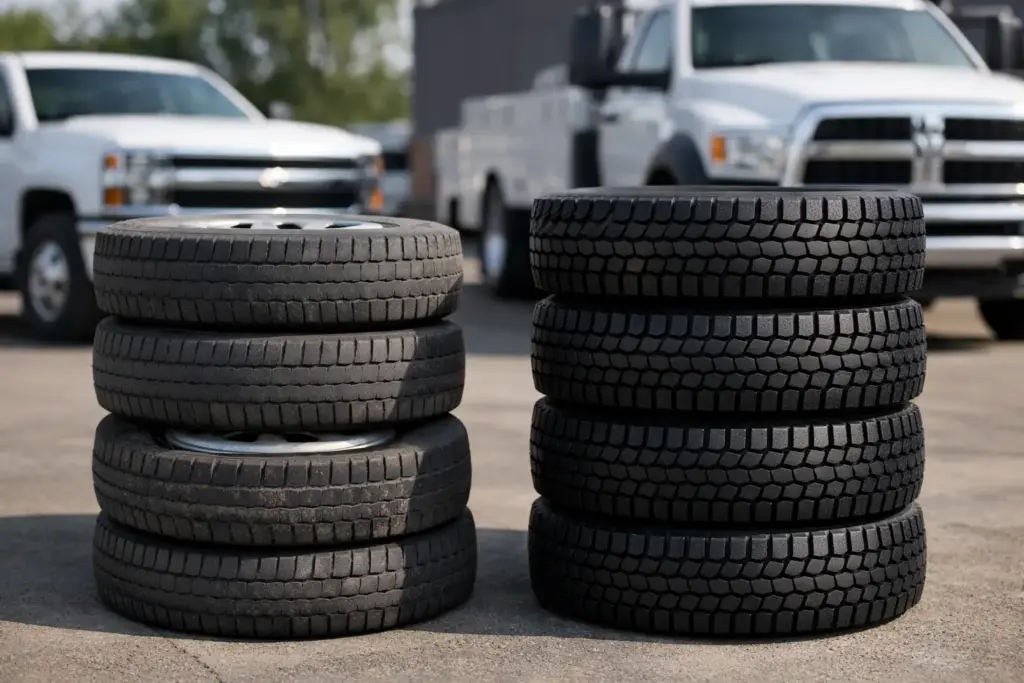
Takeoff Tires vs New Tires for Work Trucks
Jul
A set of takeoffs can save a contractor, fleet operator, or off-road owner serious money – but only when the tires match the job. The real question in takeoff tires vs new tires is not which option is universally better. It is whether the tire’s actual condition, age, specifications, and remaining service life justify the price for your truck, trailer, equipment, or specialty vehicle.
For buyers running commercial trucks, farm machinery, military vehicles, industrial equipment, or lifted off-road rigs, the wrong tire is expensive even if the purchase price looks good. Start with fitment and duty cycle, then compare condition and total cost.
What Are Takeoff Tires?
Takeoff tires are removed from a vehicle or piece of equipment after limited use, often during an upgrade, conversion, fleet change, or wheel package replacement. Some are nearly new, with deep tread and minimal road time. Others have seen enough use that they should be treated as quality used tires, not as a substitute for new inventory.
The term describes where the tire came from, not a guaranteed condition grade. A takeoff could be an OEM tire pulled from a new truck, an aggressive mud-terrain removed for a different tread pattern, or a commercial casing taken off a vehicle during a fleet changeover. The details matter.
A proper listing should give you enough information to evaluate the tire: size, brand, tread pattern, remaining tread depth when available, load range or ply rating, DOT date code if relevant, condition notes, and whether the tire is sold individually, as a pair, or as a matched set. Photos matter too, particularly for used or surplus inventory.
Takeoff Tires vs New Tires: The Core Differences
New tires offer a known starting point. They have full original tread, no prior service history, current manufacturer production, and usually the clearest path to warranty coverage. That certainty has value when a vehicle works long highway miles, carries heavy loads daily, or cannot afford avoidable downtime.
Takeoffs trade some of that certainty for lower acquisition cost and access to specific inventory. A lightly used premium-brand tire can deliver substantial remaining life at a price below a comparable new tire. This can make sense for a seasonal farm truck, a restoration project, an off-road vehicle, a utility trailer, or equipment that needs a hard-to-find size without tying up more cash than necessary.
The difference is not simply “used versus new.” A low-mileage takeoff from a current truck may be a better operational buy than a cheap new tire with a lesser load rating, unsuitable tread, or questionable construction for the application. On the other hand, a new tire is usually the stronger choice when maximum life, predictable wear, and warranty support are priorities.
When Takeoffs Make Financial Sense
Takeoffs are strongest when they solve a specific sourcing or budget problem. If you need an original-equipment size for a pickup, SUV, work truck, military vehicle, or specialty wheel, surplus takeoffs may be available when conventional retail channels have limited options. They are also useful when replacing a damaged tire in a set that still has significant usable tread.
For price-sensitive buyers, the calculation should be based on usable tread and expected service, not the sticker price alone. A takeoff at half the cost of new can be a solid value if it has most of its tread remaining, shows even wear, and is appropriate for the load and terrain. A deeply discounted tire with irregular wear, age-related cracking, or a mismatched specification is not a bargain.
Takeoffs can also be practical for low-use assets. A trailer that moves occasionally, a farm implement used seasonally, or a project truck that sees limited miles may not require the full cost of a new tire set. That said, low annual mileage does not eliminate age concerns. Tires can deteriorate from sunlight, storage conditions, weather exposure, and long periods of sitting.
When New Tires Are Worth the Higher Cost
Buy new when the vehicle earns money every day and tire failure creates an immediate operational problem. Highway commercial trucks, service vehicles, heavy trailers, and equipment used at rated capacity benefit from the known history and full service life of new tires.
New tires are also the safer route when you need an exact matched set. Matching brand, model, size, load range, tread depth, and construction helps maintain predictable handling and wear. This is especially relevant on dual-wheel setups, all-wheel-drive vehicles, and commercial applications where uneven rolling diameter can create problems.
A new tire may cost more upfront, but it can provide a lower cost per mile if it stays in service longer, wears evenly, and carries a manufacturer warranty. For high-mileage fleets, that predictability often outweighs the savings available from takeoffs.
Check These Details Before Buying Takeoffs
A takeoff purchase should be an inspection-driven decision. Do not assume that a recognizable brand or deep-looking tread tells the whole story. Confirm the specifications printed on the sidewall and compare them with the vehicle placard, wheel rating, and intended workload.
Pay close attention to these points:
- Size and construction: Confirm section width, aspect ratio, wheel diameter, radial or bias construction, and any fitment requirements for your wheels or vehicle.
- Load rating and speed rating: A tire must meet or exceed the required load capacity. For trailers, commercial trucks, and equipment, this is not an area to compromise.
- Tread depth and wear pattern: Measure remaining tread across the tire. Cupping, shoulder wear, feathering, or one-sided wear may point to alignment, suspension, inflation, or prior service issues.
- Age and physical condition: Check the DOT date code, sidewalls, bead area, and tread for cracking, cuts, puncture repairs, bulges, exposed cords, or weather checking.
- Set matching: For multi-tire applications, compare actual tread depth and overall diameter. A set that looks similar may not be close enough for the axle or drivetrain.
If the tire will be used on a high-speed road vehicle, heavy trailer, or commercial unit, have it inspected and mounted by a qualified tire professional. A visual review before purchase is useful, but it does not replace proper mounting, inflation, balancing where required, and follow-up checks under service.
Tread Pattern Still Has to Match the Job
A common mistake is buying takeoffs because the price is right, then discovering the tread is wrong for the work. Highway rib tires are built for different conditions than all-terrain, mud-terrain, traction, R-1 agricultural, flotation, or industrial patterns.
For example, an aggressive off-road takeoff may look nearly unused but deliver more road noise, faster highway wear, and worse fuel economy than a highway tire. A commercial steer tire may have excellent remaining tread but be unsuitable for a drive axle application. Agricultural and OTR tires require an even more careful review of ply rating, load capacity, rim compatibility, and the ground conditions they will face.
The best purchase is the tire that fits the operation, not the tire with the deepest discount.
How to Compare the Real Cost
Use a simple service-life comparison. Price the takeoff set against an equivalent new set, then consider remaining tread, installation costs, expected usage, downtime risk, and how long you plan to keep the vehicle. A nearly new takeoff set can be an excellent buy. A mixed set that needs replacement again next season can cost more after mounting, balancing, and lost time.
For a fleet or shop, consistency may be worth paying for. For a collector vehicle, utility trailer, or occasional-use machine, a good surplus takeoff may be the practical answer. Wholesale buyers and resellers should also account for inspection time, storage, shipping, and the ability to match inventory into saleable sets.
Specialty inventory changes quickly, particularly in uncommon military, commercial, agricultural, and off-road sizes. When a takeoff matches your required size, load rating, tread type, and condition target, it can be a smart way to put proven premium rubber back into service without paying full new-tire pricing.
Before committing, match the sidewall specs to the work, inspect the condition honestly, and buy for the miles or hours the vehicle actually needs to deliver.
