

Uncategorized
Michelin XZL Tire Review: Worth the Cost?
Jun
If you are looking at this Michelin XZL tire review, you are probably not shopping for a basic highway tire. The XZL sits in a different category – military-spec, heavy-duty, and built for operators who care more about load, traction, and casing strength than quiet road manners. That makes it a serious option for military truck owners, expedition builds, utility fleets, and buyers trying to source a proven off-road tire that can still survive pavement.
The short version is straightforward. The Michelin XZL has a strong reputation for durability, off-road bite, and load-carrying ability. It is not cheap, it is not light, and it is not the right answer for every truck. But in the right application, it earns its reputation.
Michelin XZL tire review: what it is built for
The XZL was designed for military and severe-service use, and that matters. This is not a commercial all-terrain dressed up with aggressive tread. It was built to handle mixed terrain, high load demands, and conditions where sidewall damage, uneven surfaces, and rough service are part of the job.
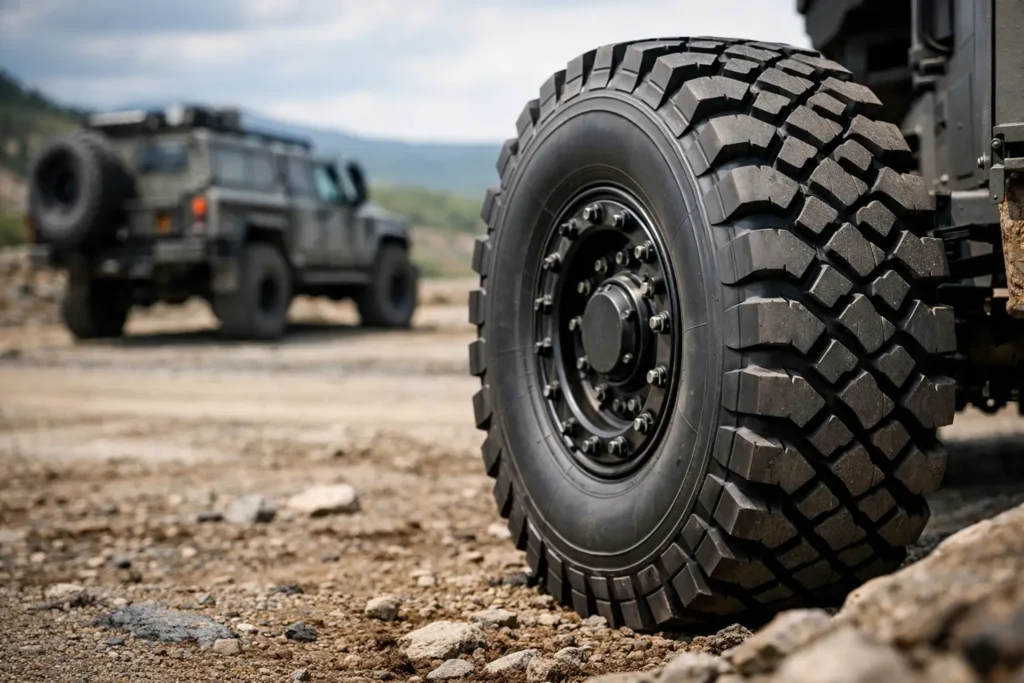
That purpose shows up in the casing and tread design. The XZL typically has a deep, block-style tread pattern with enough void to clear dirt and loose material while still keeping a stable footprint on harder surfaces. The sidewalls are built with toughness in mind, and the overall construction feels more like equipment tire engineering than light-truck marketing.
For buyers running military surplus trucks, larger 4×4 platforms, or specialty commercial equipment, that is the appeal. You are getting a tire with a service background that goes beyond weekend trail use.
On-road behavior: better than expected, but still a compromise
One reason the XZL keeps drawing attention is that it does not behave as badly on pavement as many buyers assume. For a military-pattern tire, road handling is generally respectable. The casing is stable, the tread blocks do not feel overly vague, and at the right inflation pressure the tire tracks with more confidence than many deep-lug alternatives.
That said, this is still a heavy-duty off-road tire. Ride quality depends a lot on vehicle weight, suspension setup, and air pressure. On a properly matched truck, the XZL can feel solid and predictable. On a lighter build, it can ride stiff and transmit more road texture than a conventional all-terrain.
Noise is another trade-off. It is usually quieter than some extreme off-road tires, but nobody should buy an XZL expecting passenger-tire manners. If your truck spends most of its life at highway speed and only occasionally leaves pavement, there are better road-focused choices. The XZL makes more sense when road use is part of the job, not the whole job.
Wet pavement and braking
Wet-road performance is decent for the category, but expectations should stay realistic. The tread is designed around traction in variable terrain, not maximum rain-groove performance at commuter speeds. On a heavy vehicle with proper maintenance and correct pressures, braking and grip are manageable. On lighter trucks or poorly matched conversions, stopping distances and wet handling can feel less forgiving.
This is where application matters. A military cargo truck, service truck, or expedition platform can make good use of the XZL. A daily-driven pickup that rarely carries real weight may not.
Off-road traction is where the XZL earns its name
In dirt, gravel, broken ground, and rocky terrain, the XZL usually performs the way buyers hope it will. The tread pattern gives solid forward drive, the casing stands up well under load, and the tire has enough structure to handle uneven terrain without feeling fragile.
Mud performance is good, though not unlimited. The XZL clears better than a road-biased tire and can work well in loose or wet ground, but it is not a dedicated mud tire. In thick, deep mud, a more open agricultural or extreme mud-terrain design may outperform it. That does not make the XZL weak – it just means Michelin built it as a multi-surface service tire, not a swamp tire.
On rock and hard trail surfaces, the XZL often gets high marks for predictable grip and sidewall confidence. Buyers running heavier rigs appreciate that the tire feels built to take abuse. That matters when you are far from pavement and downtime costs money or time.
Durability and casing strength
This is one of the strongest arguments in favor of the XZL. Michelin built the tire with a reputation for casing quality, and in severe-use markets that reputation carries weight. The XZL is known for strong construction, good resistance to impacts, and long service potential when used in the right load range and inflation window.
For commercial operators and military vehicle owners, casing quality matters just as much as tread life. A tire that resists damage, supports retreadable value in some markets, and holds up under harsh terrain is worth more than a cheaper tire that fails early. That is where the XZL often justifies its higher price.
There is one caution here. A lot of XZL inventory in the market comes from surplus channels, and condition varies. New old stock can be an excellent value if storage conditions were good and date codes make sense for the intended use. Used tires can also be viable, especially for lower-mileage specialty vehicles, but buyers need to pay close attention to tread depth, sidewall condition, repairs, and age. The tire itself is capable. The specific piece of inventory still needs inspection.
Michelin XZL tire review on sizing and fitment
Fitment is where many buyers get into trouble. XZL sizes are often tied to military and specialty applications, not standard consumer fitment charts. You will see sizes that work well on deuce-and-a-half trucks, 5-ton trucks, Pinzgauers, Unimogs, older Land Rover military conversions, and various expedition platforms. That does not mean every size is a drop-in swap for a civilian truck or trailer.
Before buying, check overall diameter, section width, wheel compatibility, load rating, and dual-spacing requirements if applicable. Clearance, gearing, brake fitment, and steering components all need to be considered. A tire this specialized can solve a sourcing problem fast, but only if the measurements line up with the vehicle.
For wholesale buyers and resellers, this is also where the XZL has value. It serves a market that often knows exactly what it needs and cannot source it through standard retail channels.
Cost and value
The XZL is rarely the cheapest option in any size category. Michelin name recognition plays a role, but the bigger factor is the tire’s build quality and niche demand. Buyers are paying for a military-grade casing, severe-service design, and a product that is still sought after in specialty equipment circles.
Whether it is worth the price comes down to use case. If you need a hard-to-find tire for a military restoration, a working off-road truck, or a specialty fleet unit, the value is easier to justify. If you are simply chasing an aggressive look for a truck that sees mostly pavement, the money is harder to defend.
Surplus availability changes the equation. In that market, buyers can sometimes find XZL inventory at a more practical price point, especially if they are open to used or new old stock options. That is one reason specialized sellers such as MilitaryTires.ca continue to move these tires – there is steady demand from buyers who understand what the XZL is and what it is not.
Who should buy the Michelin XZL
The best buyer for an XZL is someone with a clear application. Military vehicle collectors, off-road service operators, expedition truck builders, agricultural users with specialty equipment, and commercial buyers needing severe-service fitments all fall into that category. They want load capacity, sidewall strength, and off-road reliability more than comfort and low rolling resistance.
The wrong buyer is someone trying to turn a highway truck into something it is not. If your priority is daily driving, fuel economy, and quiet cruising, the XZL will feel like overkill and expense without much return.
The real verdict
The Michelin XZL is a purpose-built tire with a real track record. It delivers strong off-road traction, serious casing strength, and dependable service in applications that punish ordinary tires. It also brings the usual costs of that capability – more weight, more road compromise, and a higher buy-in.
For the right truck and the right job, it is a legitimate heavy-duty solution, not just a surplus curiosity. Buy it because you need what it was built to do, and it makes sense. Buy it just for appearance, and there are cheaper ways to get the look. The smart move is to match the tire to the work, then buy the best condition and fitment you can find.
