A low-hour military truck, a farm trailer, a loader, or a restoration project can be stopped cold by one hard-to-find tire size. That is why NOS inventory gets attention. But knowing how to evaluate NOS tires matters before price becomes the deciding factor. New old stock can be an excellent buy, but it is not the same as current-production stock just because the tire has never been mounted.
NOS means new old stock: a tire that was manufactured some time ago, remained unsold, and may have spent years in warehouse, government, dealer, or surplus storage. The casing may be unused and the tread may be full depth. Its suitability still depends on age, storage history, construction, and whether it matches the job you expect it to do.
How to Evaluate NOS Tires: Start With the Date Code
For DOT-marked highway tires sold in the United States, begin with the DOT date code. The final four digits identify the week and year of manufacture. For example, a tire marked 2321 was made during the 23rd week of 2021. Ask for a clear photo of the complete DOT marking if it is not shown in the listing.
Age does not automatically make an unused tire unsafe or unsuitable. A properly stored tire may remain in far better condition than a newer tire left outdoors in sun, heat, and weather. Still, a 15-year-old NOS tire deserves a different level of scrutiny than a three-year-old surplus tire. This is especially true for highway use, high-speed use, passenger applications, and equipment that carries people.
There is no single age limit that fits every tire and every application. Tire maker guidance, vehicle manufacturer requirements, local regulations, operating speed, load, inflation pressure, and storage conditions all matter. A low-speed implement tire or military vehicle tire used occasionally is not evaluated the same way as a commercial steer tire running daily at highway speed.
Some specialty, military, agricultural, industrial, and aircraft tires may have markings that differ from a standard consumer DOT tire. In those cases, confirm the manufacturing information, part number, and intended application directly from the tire markings and available documentation.
Inspect the Rubber, Not Just the Tread
Full tread depth is expected on NOS tires. It is not proof that the tire is ready for service. Rubber changes with time, particularly when exposed to ozone, ultraviolet light, heat, petroleum products, and repeated temperature swings.
Start with a close visual inspection under good light. Look at the sidewalls, tread grooves, bead area, inner liner, and shoulder transitions. Surface dust or warehouse grime is one thing. Cracking, hardening, distortion, or suspicious staining is another.
Pay close attention to these condition issues:
- Fine cracks in sidewalls, between tread blocks, or at the base of grooves
- Deep checking around the bead or signs of bead damage from poor handling
- Flat spots, deformed sidewalls, bulges, or irregular shape from long-term stacking
- Loose, lifting, cut, or separated-looking tread and belt areas
- Dry, chalky, unusually hard rubber or sticky areas caused by chemical exposure
- Evidence of prior mounting, repairs, plugs, patches, or sealant despite an NOS description
A few light surface marks may be acceptable on a tire intended for a limited-use off-road project. Cracking that reaches into the rubber, a bulge, damaged bead wire, or suspected separation is not a bargain. Walk away from it.
If you can inspect the tire in person, press the sidewall and look for uniform flexibility. Do not treat this as a lab test, but compare several tires from the same lot. One tire that feels markedly harder, looks more faded, or carries a different date code may have had a different storage history.
Storage History Can Make or Break NOS Value
The best NOS tires are generally stored indoors, dry, clean, and away from direct sunlight, electric motors, welding areas, fuel, solvents, and ozone-producing equipment. Proper storage limits the environmental factors that age rubber before the tire ever sees service.
Ask practical questions about where the tires came from and how they were stored. Government surplus, dealer liquidation, warehouse closeouts, and fleet overstock can all produce good inventory. The source alone is not a condition guarantee. Tires stored on racks in a controlled warehouse are a different proposition than tires left outside under a tarp for years.
Also consider how the tire was positioned. Long-term improper stacking can distort heavy commercial, OTR, and military tires. Tires stored vertically can develop issues if they were never rotated. Large tires that have been compressed under excessive weight may show shape changes even when they have never been mounted.
For a bulk purchase, request photos from more than one tire in the lot. Do not assume every tire is identical because the first photo looks clean. Check the dates, sidewall condition, markings, and visible storage wear across the group.
Confirm Fitment and Service Rating Before Buying
NOS does not solve a fitment problem. A tire can be clean, rare, and competitively priced while still being wrong for your wheel, axle, machine, or duty cycle.
Verify the full tire size, not just the outside diameter or section width. Check the rim diameter, approved rim width range, load range or ply rating, load index, speed symbol where applicable, and required inflation pressure. On military and specialty tires, confirm the exact nomenclature, NSN or part number when available, and whether the tire is designed for a standard wheel, split rim, beadlock, or run-flat system.
Tread design matters as much as size. A bar tread agricultural tire, an MPT tire, a highway rib tire, and an aggressive off-road traction tire serve different purposes. Deep lug tread may be ideal for soft ground but wear poorly on pavement. A military tire may offer excellent load capacity and sidewall protection while creating more road noise, weight, and rolling resistance than a conventional commercial tire.
For dual applications, match overall diameter and construction closely across the pair. On four-wheel-drive equipment and vehicles, diameter differences can affect driveline behavior. If you are replacing one tire in a set, compare measured diameter and rolling circumference where the application requires it, not only the molded size on the sidewall.
Consider the Cost Beyond the Purchase Price
NOS tires are often attractive because they offer uncommon sizes, full tread, and surplus pricing. That value is real when the tire is correct for the application. It disappears quickly if the tire requires a hard-to-find tube, specialty flap, unusual rim, expensive freight handling, or early replacement because it was too old or poorly stored for the intended use.
Calculate the landed cost. Include shipping, cross-border requirements if applicable, mounting, balancing, tubes, flaps, valve hardware, disposal fees, and any wheel work. Large military, agricultural, aircraft, and OTR tires can be costly to move and mount. A no-reserve auction price is only part of the purchase decision.
For fleet, resale, or multi-unit projects, consistency is worth paying for. A matched lot with similar date codes, uniform condition, and the same tread pattern is easier to install, maintain, and resell than a mixed group of bargain tires from different storage environments.
Know When NOS Is the Right Choice
NOS makes the most sense when current production is unavailable, the tire is needed for a period-correct restoration, the equipment sees limited or low-speed use, or the surplus tire meets your service requirements at a meaningful cost advantage. It can also be a practical answer for specialty military, industrial, farm, and off-road sizes that are difficult to source through standard tire channels.
It may not be the best choice for high-mileage highway fleets, daily passenger transportation, or applications where manufacturer age recommendations rule out older stock. In those cases, current-production tires usually provide more predictable service life and easier warranty support.
Before committing, get the facts that matter: manufacture date, close-up condition photos, quantity available, exact size and rating, and any known storage details. MilitaryTires.ca buyers often shop for inventory that cannot be found at a local tire counter, so the job is not simply finding a tire. It is verifying that the tire will do the job safely and economically.
A clean NOS tire with the right date, correct rating, sound storage history, and proper fitment can put hard-to-find equipment back to work. Treat it like specialized inventory, not a generic bargain, and let the inspection decide whether the price is truly worth buying.


 25X10-12 Goodyear TRACKER MUD RUNNER
1 × $80.00
25X10-12 Goodyear TRACKER MUD RUNNER
1 × $80.00 
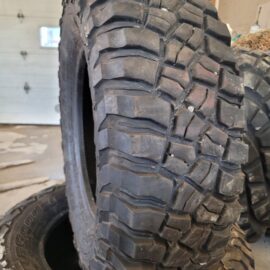 lt245/75r17 bfgoodrich mud terrain km3
1 × $110.00
lt245/75r17 bfgoodrich mud terrain km3
1 × $110.00  14.9-24 C TL Titan Torc Trac R-3
1 × $295.00
14.9-24 C TL Titan Torc Trac R-3
1 × $295.00  12x7 UTV/ATV Wheel
1 × $40.00
12x7 UTV/ATV Wheel
1 × $40.00  25.5X8.0-14 Michelin air MWL-4
1 × $300.00
25.5X8.0-14 Michelin air MWL-4
1 × $300.00