

Uncategorized
Military Tires vs Mud Tires: What Fits Best?
Jul
A lot of buyers lump these into the same bucket because both look aggressive and both promise off-road traction. That is where bad purchasing decisions start. When you compare military tires vs mud tires the real question is not which one looks tougher – it is which one matches your vehicle, load, terrain, and how often that machine actually sees pavement.
If you are outfitting a work truck, surplus rig, farm unit, trail build, or specialty equipment, tread style alone will not tell you enough. Military-spec tires and consumer mud-terrain tires are built around different priorities. One may give you the durability and load support you need. The other may be the better fit for mixed off-road use, highway travel, and easier sourcing.
Military tires vs mud tires: the core difference
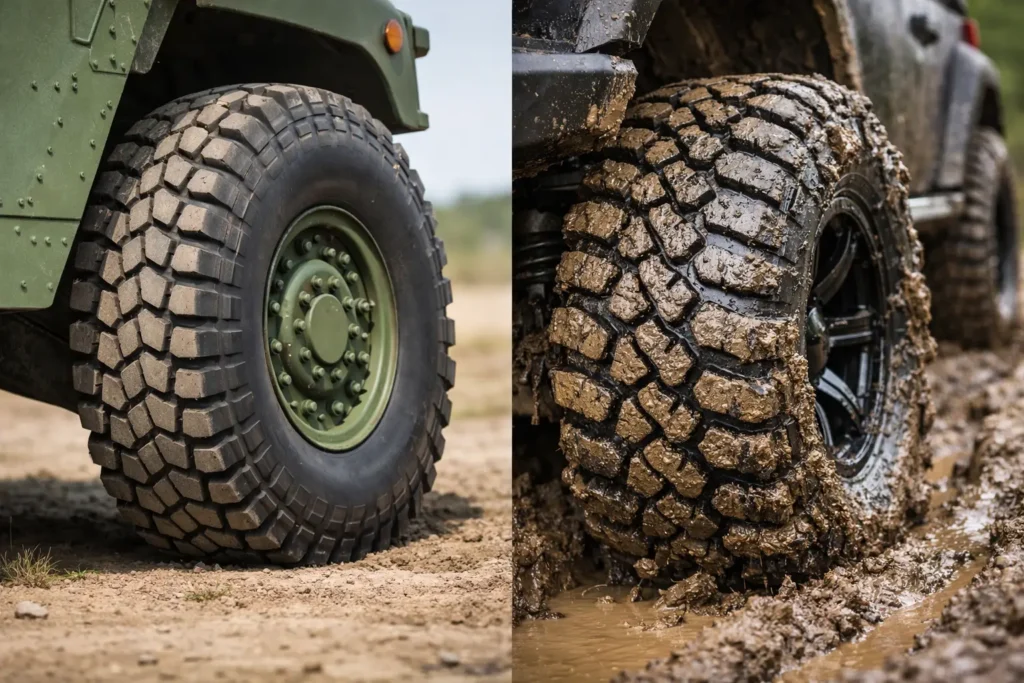
Military tires are typically designed around service use, heavy loads, rough ground, puncture resistance, and operational durability. Many are made for military trucks, trailers, and support vehicles that carry weight in poor conditions and run in places where tire failure is more than an inconvenience. Depending on the size and application, they may use stiff sidewalls, heavy carcass construction, and tread patterns built to keep moving in dirt, gravel, rock, sand, and broken terrain.
Mud tires, usually sold as mud-terrain or M/T tires, are designed primarily for civilian off-road use. They focus on self-cleaning tread voids, forward bite in deep mud, and better compatibility with pickup trucks, Jeeps, SUVs, and recreational trail vehicles. They are aggressive, but they are still part of the consumer tire market. That means fitment, road manners, and replacement availability are often easier to manage than with military surplus tires.
This is why the comparison is not really about which tire is more aggressive. It is about intended use. A military tire may be tougher in certain ways, but that does not automatically make it the right choice for a daily-driven 4×4. A mud tire may be better on a weekend trail truck, but that does not mean it can match a military tire for weight capacity or abuse tolerance.
Tread design and off-road traction
Mud tires usually win the mud-specific argument. Their large tread blocks and wide voids are built to eject mud quickly. In deep, wet terrain where the tire has to keep clearing itself to maintain bite, a good mud tire has a clear advantage. That is the reason they are popular with recreational off-road owners who spend real time in swampy trails, ruts, and soft ground.
Military tires vary a lot more. Some military tread designs are excellent in mixed terrain, especially on loose surfaces, gravel roads, rocky sections, and general unimproved ground. Some are less specialized for thick mud than a true mud-terrain tire. Others are designed for a broader mission profile, not just one type of off-road terrain. That broader design can be a strength if your vehicle sees changing conditions, but it can also mean less focused mud performance.
So if your priority is mud first and everything else second, a mud tire often makes more sense. If your vehicle works across dirt, rock, hardpack, rough access roads, and loaded ground conditions, military tread can be the better tool.
Sidewall strength, load rating, and durability
This is where military tires often separate themselves.
Military applications demand durability under load. That can mean heavier construction, stronger sidewalls, and a design built to tolerate hard impacts, rough surfaces, and long service life in punishing conditions. For commercial operators, collectors restoring military vehicles, or buyers dealing with heavy equipment and utility platforms, that matters more than having the most aggressive tread void.
Mud tires can still be very durable, especially premium models from established brands, but they are generally designed around the consumer off-road market. That includes trail use, overlanding, modified trucks, and mixed highway driving. They may offer reinforced sidewalls, but they are not automatically in the same class as a true military-spec tire built for heavier vehicle systems.
The trade-off is weight and stiffness. A military tire may give you more toughness, but it can also be harder riding, heavier to handle, and less forgiving on light vehicles. That affects steering feel, braking, fuel use, and suspension behavior.
Road manners and daily use
If the vehicle spends regular time on pavement, mud tires usually have the edge.
Most civilian mud tires are still loud compared to all-terrain or highway tires, but they are built with road use in mind. They are easier to match to common wheel sizes, easier to balance in many cases, and usually more predictable for drivers who split time between pavement and trail. You still get noise, tread wear, and some reduction in wet-road refinement, but the compromise is often manageable.
Military tires can be a different story. Depending on the size, age, design, and condition, they may ride rough, track differently, create more noise, and feel less refined at speed. Some were never intended to deliver passenger-vehicle comfort. Some surplus inventory may also reflect older production designs that prioritize function over road manners.
That does not make them a poor product. It means the buyer has to be honest about the application. If the truck is a parade vehicle, farm truck, military restoration, dedicated off-road platform, or low-mileage utility unit, road comfort may not matter much. If it is your everyday pickup, it matters a lot.
Fitment is where many buyers get it wrong
The biggest mistake in military tires vs mud tires is assuming both are easy swaps. They are not.
Mud tires are sold into standard consumer fitment channels. Sizes, wheel diameters, speed ratings, and load ranges are generally easier to cross-reference with common light truck applications. If you run a modern pickup or SUV, the path from selection to installation is usually straightforward.
Military tires often require more attention. Overall diameter, section width, wheel type, bolt pattern, backspacing, bead seat compatibility, and load requirement all need to be checked carefully. Some military wheels and tires were designed as a complete system, not as a casual replacement for civilian truck equipment. Some buyers also overlook clearance issues. A tire that fits on paper may still create steering rub, suspension interference, or gearing problems.
This is especially important with surplus inventory. Condition, age, tread depth, and intended application should all be reviewed before purchase. If you are buying used or new old stock, the value can be strong, but only if the tire actually fits the machine and the job.
Cost, availability, and replacement planning
Mud tires are easier to replace quickly in most local markets. That matters if downtime costs money or if you want a matching spare without a long sourcing cycle. Consumer distribution is broader, and size availability is generally better for mainstream truck and SUV platforms.
Military tires are a different buying category. Some sizes and tread patterns are hard to find through ordinary tire dealers, while surplus channels may offer excellent value on exactly the kind of tire mainstream sellers do not keep. That is one reason specialized inventory matters. A buyer looking for military takeoffs, surplus assemblies, or less common heavy-duty sizes is not shopping the same market as a weekend off-road owner buying a set of 35s.
The catch is replacement planning. If you need one tire six months later, can you get the same make, size, and condition again? Sometimes yes, sometimes no. Buyers who run military tires should think beyond the first purchase and consider spare strategy, matching inventory, and future availability.
Which tire should you buy?
If you run a civilian 4×4, trail truck, hunting rig, or mixed-use pickup that still sees highway miles, mud tires are usually the more practical choice. They are built for off-road traction without creating as many fitment and drivability headaches. For most retail truck owners, that matters.
If you are outfitting a military vehicle, heavy utility platform, farm truck, industrial unit, or commercial application where load, toughness, and specialty sizing matter more than comfort, military tires may be the better answer. That is especially true when you need hard-to-find sizes, military-spec construction, or surplus value that standard dealers do not offer.
There is also a middle ground. Some buyers want the look and strength of military-style tires but do not actually need military-spec performance. Others think they need mud tires when the vehicle really spends more time on gravel roads, job sites, and packed dirt than in deep mud. Buying by appearance usually costs more in the long run than buying by use case.
For buyers sourcing specialty inventory, one of the biggest advantages of a supplier like MilitaryTires.ca is access. When you need a specific military size, takeoff, surplus casing, or wheel-and-tire combination, broad inventory matters more than showroom polish.
The right tire is the one that carries the load, clears the vehicle, survives the terrain, and does not create avoidable problems on the ground you actually drive. Start there, and the choice gets a lot clearer.
