

Uncategorized
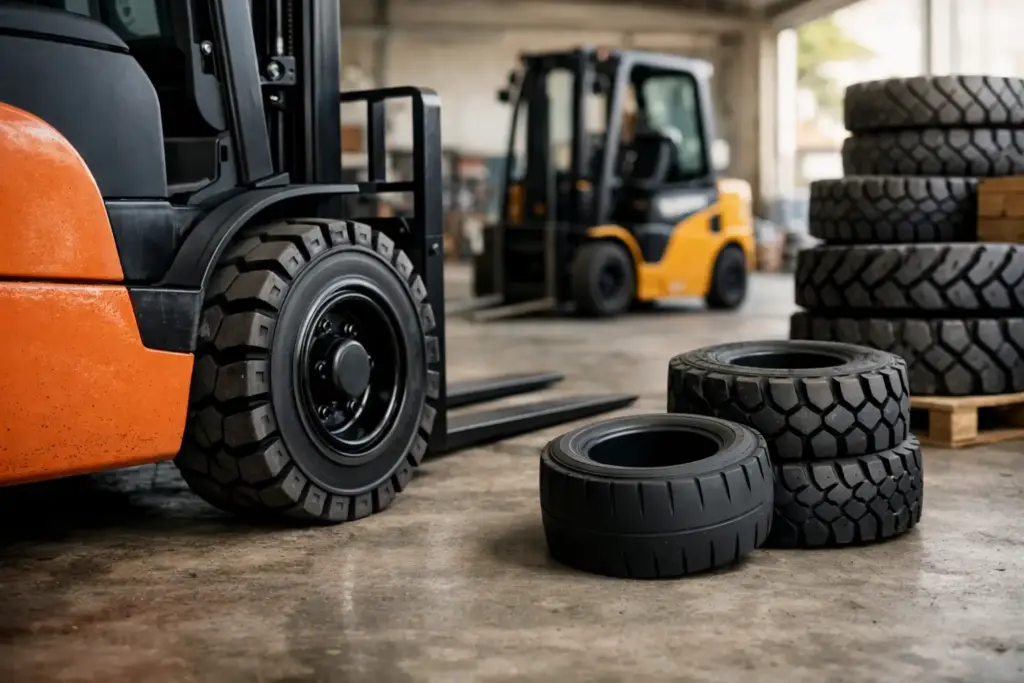
Forklift Tires That Match Your Workload
Sep
A forklift that spins its drive tires on a wet dock floor, pounds across broken yard pavement, or leaves black marks through a food-grade warehouse has the same problem: the tire does not match the job. Forklift tires are a working component, not an accessory. The right construction affects traction, load stability, operator comfort, fuel or battery use, floor wear, and how often the truck is parked for service.
For fleet managers, shop owners, contractors, and equipment buyers, the lowest purchase price is rarely the full cost. A tire that wears quickly, damages the work surface, or loses traction under load can cost more in downtime than a better-matched set. Start with the operating environment, then verify the tire size, load capacity, wheel fitment, and clearance requirements for the forklift.
Start With the Surface and Duty Cycle
Before choosing a tread pattern or tire type, look at where the forklift spends most of its operating hours. Smooth concrete, rough asphalt, compacted gravel, warehouse aisles, lumber yards, loading docks, and mixed indoor-outdoor routes place very different demands on the tire.
A forklift used inside a clean warehouse generally needs predictable handling, low rolling resistance, and minimal floor marking. A truck that moves pallets from a warehouse to an outdoor yard needs more traction and impact resistance. A machine working around scrap, construction debris, or broken pavement needs protection against cuts, punctures, and sidewall damage.
Duty cycle matters just as much. A forklift that makes occasional short runs can tolerate trade-offs that would be costly on a truck running two shifts every day. High-hour operations should prioritize heat management, wear life, and service intervals. Loads also matter. Repeatedly lifting near the truck’s rated capacity creates more tire deflection and heat than light picking work, especially during tight turns.
Main Types of Forklift Tires
Cushion Tires
Cushion tires are solid rubber tires pressed directly onto a metal wheel or band. They are common on electric and internal-combustion forklifts used on smooth, dry, level floors. Their compact profile allows a tight turning radius and lower overall truck height, which can be useful in warehouses with limited aisle space or low overhead clearance.
The trade-off is ride quality. Cushion tires have little give, so operators feel cracks, expansion joints, and rough pavement. They are not the right choice for extended outdoor use, uneven yards, or areas where loose material and poor surfaces are part of the daily route. They can also wear aggressively when used on abrasive concrete or asphalt beyond their intended application.
For indoor fleets, cushion tires remain a practical choice because they are simple, stable, and efficient on the surfaces they are designed for. Buyers should still confirm whether non-marking compound is required. Non-marking tires help protect floors, but they may wear differently and can carry a price premium compared with standard black rubber.
Pneumatic Tires
Pneumatic forklift tires use an air-filled casing, much like a truck or industrial tire. They provide better cushioning, traction, and ground clearance than cushion tires. That makes them a common fit for outdoor yards, loading areas, farms, construction sites, and mixed-surface operations.
Air-filled pneumatic tires can be a strong option where ride comfort matters or where the forklift travels over potholes, gravel, uneven pavement, and dock transitions. They also come in tread designs suited to different conditions, from block patterns for hard surfaces to deeper traction lugs for loose ground.
Their weakness is puncture exposure. Nails, scrap metal, sharp rock, and damaged pavement can put an air-filled tire out of service. Correct inflation is also critical. An underinflated tire runs hot, handles poorly, and can reduce stability under load. An overinflated tire rides harshly and may wear unevenly. Check pressure when the tire is cold and use the forklift manufacturer’s specifications, not a guess based on appearance.
Solid Pneumatic Tires
Solid pneumatic tires are engineered to fit pneumatic-style wheels but contain no air chamber. They are built in layers, typically with a hard base, a resilient center section, and a wear-resistant tread. For puncture-prone yards, recycling operations, scrap handling, demolition work, and heavy industrial sites, they can remove a major source of unplanned downtime.
The trade-off is higher initial cost and a firmer ride. Solid tires add weight and do not absorb impacts as well as air-filled versions. On very rough ground, that can increase operator fatigue and transmit more shock through the truck. Still, where flat repairs are frequent, solid tires often make commercial sense because the forklift stays in service.
Read the Size and Fitment Before You Buy
Forklift tire sizing is not always as straightforward as passenger vehicle sizing. A marking such as 7.00-12, 8.25-15, or 250-15 may identify section width, rim diameter, and construction style, but formats vary by tire type and manufacturer. Some forklift tires use inch-based sizing, while others use metric or millimeter designations.
Do not order solely by outside diameter or a photo of the old tire. Verify the complete sidewall marking, wheel type, rim width, bolt pattern where applicable, and whether the tire is a press-on cushion or a pneumatic-style tire. Also confirm clearance around fenders, mast components, and steering axle parts. A tire that technically mounts but changes overall diameter can affect clearance, speed indication, and truck behavior.
Load capacity is non-negotiable. The tire must be rated for the axle load and the forklift’s real operating conditions. Attachments, uneven load distribution, high lift heights, and frequent travel with heavy loads can change the demand placed on the tires. If the forklift has a clamp, rotator, carton attachment, or other specialized equipment, review the truck data plate and tire requirements before selecting a replacement.
Tread, Compound, and Operating Conditions
Tread is where many buyers either solve a traction problem or create a wear problem. Deep, aggressive lugs may help on dirt, snow, or loose material, but they can wear faster on hard concrete and make steering less precise indoors. A flatter industrial tread often wears well on paved surfaces and provides a stable contact patch, but it may struggle in mud or wet, loose terrain.
Rubber compound matters too. Standard black tires are generally a practical choice for outdoor and industrial work. Non-marking tires are often required in warehouses, food handling areas, retail facilities, and finished-floor environments. Specialty compounds may be selected for heat resistance, cold conditions, or high-abrasion service, depending on availability and application.
Used tires and new old stock can offer real value when the condition and fitment are clearly understood. For used inventory, inspect tread depth, sidewall damage, repairs, uneven wear, bead condition, and age-related cracking. New old stock may have unused tread but still requires inspection for storage damage and rubber condition. For low-hour equipment, backup units, restoration projects, or price-sensitive fleets, surplus inventory can be a practical sourcing option when specifications match.
When to Replace Forklift Tires
Do not wait for a complete failure. Forklift tires should be inspected as part of routine equipment checks. On solid tires, wear indicators or safety bars provide a clear replacement reference. Once the tire is worn to the indicator, the truck loses ground clearance and can become less stable. On pneumatic tires, replace tires with exposed cords, serious cuts, sidewall bulges, repeated air loss, severe cracking, or tread wear that compromises traction.
Watch for uneven wear as well. Excessive wear on one edge can point to alignment issues, worn steering components, incorrect inflation, overloaded use, or operator habits such as hard turning under load. Replacing tires without correcting the cause only starts the wear cycle again.
A quick buying check should cover five items:
- Tire type: cushion, pneumatic, or solid pneumatic.
- Exact sidewall size and wheel compatibility.
- Required load rating for the forklift and attachment setup.
- Primary surface: smooth indoor floor, pavement, gravel, or mixed terrain.
- Condition requirement: new, new old stock, or inspected used inventory.
Buy for Uptime, Not Just the Unit Price
A forklift tire purchase should support the work the machine is expected to do next month, not just get it rolling today. That may mean a non-marking cushion tire for a clean warehouse, an air-filled pneumatic tire for a mixed-use yard, or a solid pneumatic tire where punctures are part of the job.
MilitaryTires.ca carries specialized surplus and industrial tire inventory for buyers who need uncommon sizes, hard-to-source wheel fitments, and practical options across the U.S. and Canada. When reviewing available stock, compare the full specification and condition description rather than choosing by price alone.
The useful question is simple: what is stopping this forklift from working reliably? Match the tire to that answer, and the equipment has a better chance of staying productive where it earns its keep.
