

Uncategorized
Best Agricultural Tire Types for Working Land
Sep
A tractor can have the horsepower to pull the job, but the wrong tires can still leave it spinning, rutting a field, compacting a seedbed, or burning fuel on the road. The best agricultural tire types are not decided by tread appearance alone. They are chosen around the machine, the soil, the load, and the percentage of time spent in the field versus on hard surfaces.
For farm operators, contractors, and equipment buyers, tire selection is a working-cost decision. A tire that lasts on gravel may be the wrong choice in soft ground. A high-flotation tire can protect soil but may not fit under existing fenders or carry the required axle load. Start with the work, then match the tire construction and tread pattern to it.
Best Agricultural Tire Types by Application
Agricultural tires are usually grouped by tread designation and job type. The markings are useful, but they are not a substitute for checking the full tire specification. Load index, ply rating or star rating, inflation pressure, rolling circumference, approved rim width, and overall diameter all matter before buying a replacement set.
R-1 tires for standard field traction
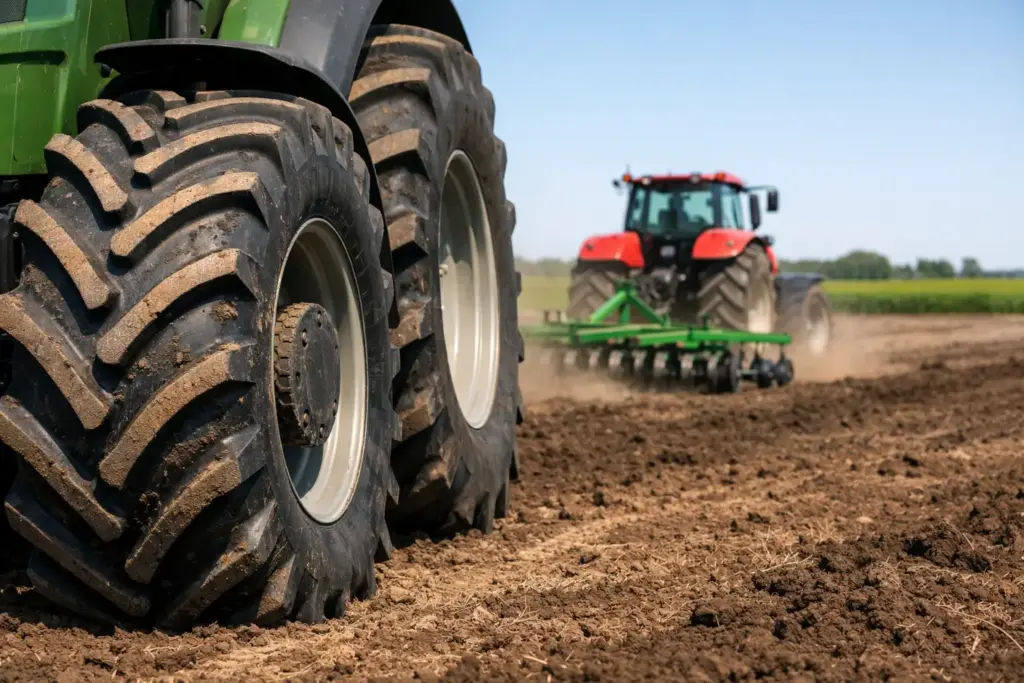
R-1 tires are the conventional agricultural lug tire found on row-crop tractors and many general-purpose farm machines. Their angled bars are designed to bite into worked soil, pasture, and moderate mud. For a tractor that spends most of its hours pulling tillage equipment, planting, mowing, or handling routine loader work, R-1 is often the practical baseline.
The trade-off is road behavior. Standard R-1 lugs can wear faster on pavement, ride rougher at transport speeds, and create more vibration than a more road-oriented pattern. They also do not perform as well in deep mud as an R-1W, and narrow R-1 fitments can put more pressure on the ground than a wider radial alternative.
R-1 tires make sense when field traction is the priority and the machine is not spending long days traveling between distant sites.
R-1W tires for wet soil and deeper mud
R-1W tires use deeper lugs than standard R-1 tires. The extra tread depth gives the tire more room to clear mud and maintain grip in wet, soft, or loose conditions. They are commonly used on tractors operating in heavy ground, low-lying fields, irrigation areas, and regions where spring or fall work regularly happens in moisture.
That added depth is useful, but it comes with a cost. R-1W tires are typically more aggressive on pavement and may wear faster if the machine sees frequent road transport. Their deeper lugs can also cause more turf disturbance during loader work around buildings, yards, or finished grounds.
If wet-field access is the issue that repeatedly delays work, R-1W is usually worth considering. If the tractor mainly runs dry ground and roads, standard R-1 may provide better value over the life of the tire.
R-2 tires for extreme wet conditions
R-2 tires are specialty rice and cane tires built with very deep, widely spaced lugs. They are intended for severe mud and saturated ground where ordinary agricultural tires pack up or lose forward movement. Their aggressive design helps self-cleaning and provides maximum bite in conditions that would stop most field equipment.
They are not a general-farm tire. R-2 tread is expensive, aggressive, and poorly suited to sustained paved-road travel. It can also tear up firmer ground that does not require that much traction. For most operations, R-2 belongs on equipment dedicated to extreme wet work, not on a tractor expected to perform every job on the property.
R-3 tires for turf, mowing, and low disturbance
R-3 tires have a shallow, wide tread designed to spread weight and reduce ground damage. They are common on compact tractors, finish mowers, golf-course equipment, estate machines, and equipment working maintained grass. The contact patch is broad, the ride is generally smoother, and the tread is less likely to scar turf during turns.
The limitation is obvious once conditions turn loose or wet. R-3 tires do not have the lug depth to pull hard in tilled soil, mud, or deep snow. A loader tractor with R-3 tires may work well on dry lawns and gravel but struggle when moving material on soft ground.
Choose R-3 when preserving the surface matters more than maximum drawbar pull. For mixed property work, many compact-equipment owners instead look at R-4 industrial tires as a compromise.
R-4 industrial tires for mixed-use machines
R-4 tires are common on compact tractors, backhoes, telehandlers, and loader-equipped machines. Their lugs are shallower and closer together than R-1 bars, with a heavier casing built for hard surfaces, gravel, construction debris, and repeated loader work. They hold up well in yards, on driveways, and around job sites.
They are a middle-ground tire, not a field-traction specialist. In dry dirt, R-4 tires often perform well enough. In wet clay, tilled ground, or mud, they can load up and lose grip sooner than R-1 tires. Their stiffer construction may also ride harder and can contribute to compaction if pressure is not managed correctly.
For a machine that spends equal time handling pallets, feeding livestock, moving dirt, and doing occasional light field work, R-4 is often the sensible fit. For serious tillage or regular wet-field work, R-1 remains the stronger choice.
Radial vs. Bias Agricultural Tires
Tread type gets attention, but construction changes how a tire works under load. Radial agricultural tires use cords that run across the casing, allowing the sidewall to flex more independently from the tread. This creates a larger, more even footprint at the correct inflation pressure. The result can be improved traction, reduced slip, better ride quality, and lower soil compaction.
Radials are a strong option for high-horsepower tractors, sprayers, and machines covering a lot of acres. They also tend to handle road travel better than many bias-ply alternatives. The purchase price is usually higher, and sidewalls can be more vulnerable in severe stubble, rock, or debris if the tire is not selected and inflated properly.
Bias tires have a firmer sidewall and simpler construction. They are often less expensive, tolerate certain hard-use applications well, and remain common on older equipment, trailers, implements, and lower-hour farm machines. Their smaller footprint and stiffer ride can be a disadvantage in field work, especially where compaction and traction efficiency are concerns.
There is no automatic winner. A radial is usually the better working tire for modern field equipment. A bias tire may be the better buy for an implement, a low-speed application, or equipment where casing toughness and upfront cost matter more than ride and footprint.
Flotation Tires for Sprayers, Wagons, and Soft Ground
Flotation tires are wide, high-volume tires built to carry load at lower ground pressure. They are used on manure spreaders, grain carts, trailers, sprayers, floaters, and other heavy equipment that needs to travel across soft or sensitive ground without cutting deep ruts.
The key benefit is soil protection. A wide tire spreads the same machine weight across more surface area, helping reduce sinkage and compaction. That can protect yield potential and keep equipment moving when narrow tires would dig in.
Fitment needs careful attention. Wider tires may interfere with frame components, fenders, row spacing, steering angle, or dual setups. They also affect rolling resistance and may not be appropriate for equipment that must travel at higher speeds. Check the manufacturer-approved rim, load capacity at operating pressure, and clearance throughout suspension or steering travel.
For sprayers, a narrow row-crop tire can be needed to clear standing crops, while a flotation setup may be better before planting or after harvest. That is a clear example of why the best tire depends on the timing of the job, not just the machine.
Implement and Trailer Tires Need Their Own Match
Farm trailers, hay wagons, planters, cultivators, and other implements do not always need tractor-style drive tires. Implement tires are designed primarily for carrying load and rolling efficiently, often at lower speeds. Common rib patterns provide stable steering and lower rolling resistance, while flotation implement tires support heavier equipment over soft ground.
Do not install an aggressive drive tire simply because it looks tougher. On a non-driven axle, the correct implement tread may reduce soil disturbance, roll easier, and provide the specified load capacity. For road-going equipment, speed rating and heat buildup matter as much as tread condition.
Used takeoffs and surplus inventory can be a practical option for trailers and implements, especially when a buyer needs a hard-to-find size or a matching pair. Inspect casing condition, sidewall weather checking, bead area, repairs, tread wear pattern, and date code before putting any tire into service. A low-price tire is not a value if its load rating or structural condition does not match the job.
How to Make the Final Choice
Before ordering, record the full sidewall size, current rim width, required load, normal inflation pressure, and machine clearance. If replacing only two tires on a mechanical front-wheel-drive tractor, confirm rolling circumference requirements. A mismatch between front and rear tire ratios can place unnecessary stress on the drivetrain.
Also be realistic about operating conditions. Field-only tractors can justify deep-lug radial R-1 or R-1W tires. Yard and loader machines may be better served by R-4. Turf equipment needs R-3. Heavy pulled equipment often benefits from flotation or implement-specific tires. Brand, condition, and price matter, but correct fitment comes first.
MilitaryTires.ca carries specialty, surplus, takeoff, and hard-to-source tire inventory for buyers who need more than standard retail options. When you find a tire in the right category, verify every specification before purchase rather than relying on tread style alone.
The right agricultural tire should make the machine easier to operate, not force the operator to work around it. Match the tire to the ground it will cover most often, keep inflation aligned with the actual load, and the equipment will spend more time working and less time leaving tracks where they do not belong.
