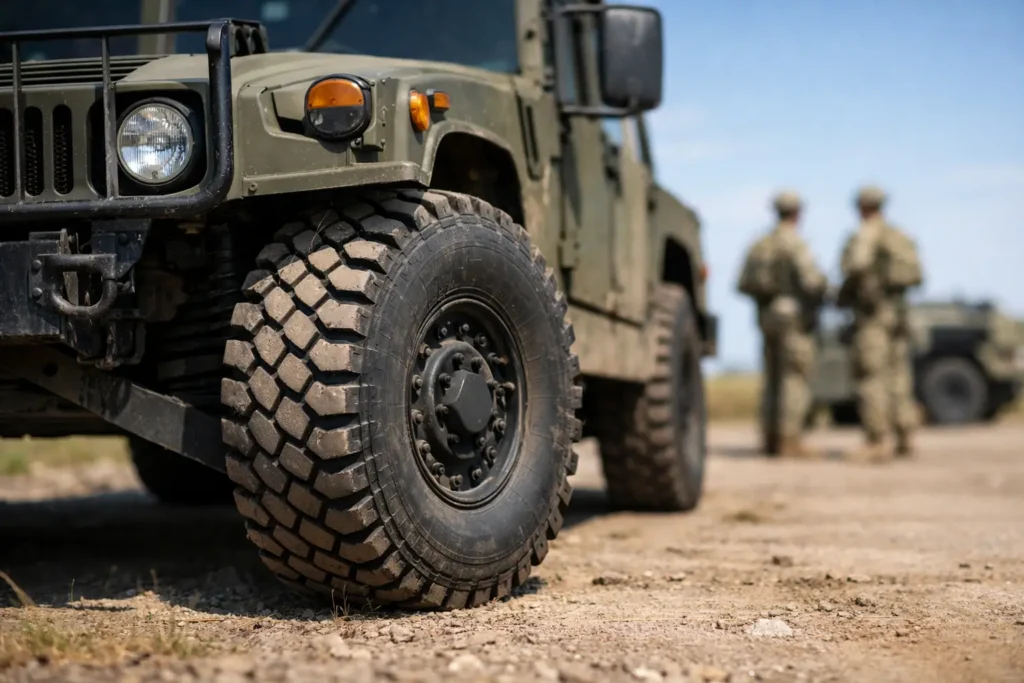
A Humvee sitting on the wrong rubber is easy to spot. The stance looks off, the ride gets harsher, and once you put weight on it or take it off pavement, the weak point shows up fast. That is why buyers shopping for military humvee tires usually are not browsing for looks. They are trying to match load capacity, wheel fitment, condition, and real-world use without wasting time on inventory that will not work.
What makes military humvee tires different
Military humvee tires are built around a vehicle that was designed for rough service, heavy loads, and low-speed off-road abuse that would shorten the life of ordinary light truck tires. That changes the buying criteria right away. You are not just looking at diameter and tread pattern. You are looking at carcass strength, sidewall construction, load range, and whether the tire was made to work with the wheel and insert setup common on Humvee platforms.
A lot of surplus buyers already know this, but it still causes problems in the market. Humvee tires often get grouped in with generic 37-inch off-road tires, and that is where expensive mistakes happen. A tire can look close on paper and still be wrong for the wheel, wrong for the vehicle weight, or wrong for the way the truck is actually used.
The other difference is sourcing. These tires often come from surplus channels, takeoffs, liquidation lots, or new old stock. That means availability can be strong one month and thin the next. For collectors, shops, and fleet-style buyers, buying when the right stock is available matters more than waiting around for a perfect listing that may not come back.
The main buying question: original use or adapted use
Before you compare brands or condition grades, decide what the truck needs to do. That sounds basic, but it is where most of the value is.
If you are restoring a military Humvee or keeping one close to original spec, your priorities are different from someone building a trail truck or a utility rig. Original-style fitment, military-spec construction, and matching sets matter more in a restoration or collector application. Cosmetic aging may be acceptable if the tire is structurally sound and the truck will see limited road use.
If the Humvee is a working vehicle, then practical factors move to the front. Tread depth, date codes, casing condition, road behavior, and replacement cost matter more than visual originality. A used surplus tire with solid tread and no structural issues may be a better buy than paying a premium just for period-correct stock.
Then there is the middle ground. A lot of buyers want a truck that looks right, works hard enough for private property or event use, and does not eat the budget. In that case, surplus takeoffs and NOS inventory often make the most sense, assuming the fitment is verified and the condition is represented clearly.
How to evaluate military humvee tires before you buy
The first checkpoint is size and wheel compatibility. Humvee wheel setups are not the same as a generic pickup wheel package, and buyers need to confirm more than just overall diameter. The wheel width, bead design, and any insert or runflat-related components all affect what will work.
The second is load rating. A Humvee is not a lightweight toy, and once you add passengers, gear, tools, or cargo, the tire has to carry the load without becoming the limiting factor. This is especially important for buyers adapting these tires to other vehicles or using them in utility applications. A tire that physically mounts is not automatically the right tire.
Condition comes next, and in surplus inventory, condition needs a practical read. Used does not automatically mean poor. New old stock does not automatically mean perfect. A used tire may have excellent remaining tread and years of service left if the casing is clean, the sidewalls are sound, and the storage history is decent. On the other hand, an NOS tire that sat improperly stored can show weathering, flat spotting, or aging that matters.
Tread pattern is another part of the decision. Aggressive military-style tread can be excellent in dirt, mud, and loose terrain, but some patterns are louder and rougher on pavement. If the truck sees mostly road miles, that trade-off matters. If it lives on trails, acreage, or work sites, road manners may be less important than bite and durability.
Surplus, used, and NOS each have a place
There is no single best category for every buyer.
Used surplus tires are often where the value is. They can give you the right size, the right construction, and usable tread depth at a lower cost than harder-to-find replacement stock. For buyers running a vehicle regularly, this can be the most efficient path, especially when buying a matched set.
NOS inventory appeals to buyers who want unused stock but are still shopping in a surplus market. The upside is obvious: unworn tread and original-spec product. The trade-off is that age and storage still matter, and pricing is usually higher than used takeoffs.
Takeoff sets are often a strong option because they may come from the same source lot and offer more consistency in wear, appearance, and construction. That matters when you want the truck to sit right and perform predictably.
For wholesale buyers and resellers, mixed lots can make sense if the condition spread is acceptable and the inventory can be sorted properly. But for an end user buying one set for one truck, consistency usually beats volume.
Why brand still matters in military humvee tires
In surplus inventory, buyers can get focused on availability and forget that brand still tells you a lot. Major military and commercial tire brands earned their place because the construction, compound, and casing quality held up under hard use.
That does not mean every tire from a known brand is automatically a safe buy. Condition still decides the real value. But recognized manufacturers generally give buyers a better baseline for load handling, build quality, and service history than no-name alternatives or loosely described off-road substitutes.
For commercial-minded buyers, the real point is replacement confidence. When you know the tire maker, the pattern family, and the military or heavy-duty application it came from, you can make a better call on whether the tire fits your use and whether it is worth buying multiple units while inventory is available.
Common mistakes buyers make
One mistake is buying on appearance alone. Military tread looks aggressive, and that can pull buyers in fast. But if the wheel fitment is wrong or the tire is mismatched to the vehicle’s actual use, the aggressive look does not help much.
Another is ignoring age because the tread looks good. Tread depth matters, but sidewall condition, storage history, and overall casing integrity matter just as much in surplus tires. A deep-tread tire that has dried out or been stored poorly may not be the bargain it first appears to be.
A third mistake is buying one or two tires now and assuming matching inventory will still be around later. Surplus stock moves in lots, and once a matched group is gone, the next batch may not be the same brand, condition, or price. If you know the fitment is right and the condition is acceptable, buying the full set is usually the smarter move.
Who should buy surplus military humvee tires
This market is not just for military vehicle collectors, although they are a major part of it. Contractors, ranch operators, off-road property owners, export buyers, rebuild shops, and tire resellers all have reasons to buy Humvee-spec tires when the right stock shows up.
Collectors want correct stance and military-spec appearance. Working users want heavy-duty construction at a better price than niche specialty replacements. Resellers want hard-to-find inventory with known demand. That mix is exactly why surplus channels stay active and why buyers who understand the specs tend to move quickly when good stock lands.
For buyers in the US who need access to hard-to-source inventory, MilitaryTires.ca fits that need because the market often comes down to who actually has the tires in stock, in usable condition, and ready to ship.
Buying military humvee tires with fewer surprises
The best purchase usually comes from asking plain questions and expecting plain answers. Confirm the size, the wheel fitment, the quantity available, the condition grade, and whether the set is matched. Ask about tread depth, visible repairs, age if known, and whether the tires came from takeoffs, surplus storage, or mixed inventory.
That is not overthinking it. It is how you avoid buying a tire that creates more work than value.
Good Humvee tires are still out there, but this is a category where details matter more than hype. Buy for the truck, buy for the load, and buy while the right inventory is still on the floor.


 16.5" x 8.25" HMMWV Wheel / 12 bolt style
3 × $75.00
16.5" x 8.25" HMMWV Wheel / 12 bolt style
3 × $75.00 
 16.00R20 Goodyear AT-2A
1 × $550.00
16.00R20 Goodyear AT-2A
1 × $550.00  19.5x7.50" HD Wheel 8 bolt
1 × $160.00
19.5x7.50" HD Wheel 8 bolt
1 × $160.00  Accuride 17.5×6.75 Dual trailer wheel
1 × $99.00
Accuride 17.5×6.75 Dual trailer wheel
1 × $99.00  15x7.50 Dayton Wheel
3 × $85.00
15x7.50 Dayton Wheel
3 × $85.00  16 inch AIRCRAFT WHEEL
1 × $545.00
16 inch AIRCRAFT WHEEL
1 × $545.00  15x7.5 L Rim 10 Hole Budd Wheel
3 × $65.00
15x7.5 L Rim 10 Hole Budd Wheel
3 × $65.00  10R22.5 Major brand on wheel 5 ton truck
1 × $100.00
10R22.5 Major brand on wheel 5 ton truck
1 × $100.00  18x5.7-8 Michelin Air MWL-6
1 × $210.00
18x5.7-8 Michelin Air MWL-6
1 × $210.00  H38X13.0-18 Dunlop
1 × $325.00
H38X13.0-18 Dunlop
1 × $325.00  14.00R24 Bridgestone VUT
3 × $250.00
14.00R24 Bridgestone VUT
3 × $250.00  10R22.5 Goodyear Endurance RSA
1 × $250.00
10R22.5 Goodyear Endurance RSA
1 × $250.00  12x7 UTV/ATV Wheel
1 × $40.00
12x7 UTV/ATV Wheel
1 × $40.00  8 inch AIRCRAFT WHEEL
1 × $545.00
8 inch AIRCRAFT WHEEL
1 × $545.00  25x14 TU 3-piece Wheel
1 × $225.00
25x14 TU 3-piece Wheel
1 × $225.00  37X12.50R16.5LT Goodyear Wrangler Enforcer MT
1 × $350.00
37X12.50R16.5LT Goodyear Wrangler Enforcer MT
1 × $350.00  Hutchinson Beadlock 20″x10″ for Tubeless set up
1 × $55.00
Hutchinson Beadlock 20″x10″ for Tubeless set up
1 × $55.00  16x6.5 Wheel Rim
1 × $100.00
16x6.5 Wheel Rim
1 × $100.00  7.50-16 LT Goodyear Workhorse on Wheel
1 × $197.50
7.50-16 LT Goodyear Workhorse on Wheel
1 × $197.50  14.00R20 Michelin XL
1 × $400.00
14.00R20 Michelin XL
1 × $400.00  20x10 Steel Beadlock Wheel
1 × $245.00
20x10 Steel Beadlock Wheel
1 × $245.00  315/80R22.5 Michelin XZUS
1 × $75.00
315/80R22.5 Michelin XZUS
1 × $75.00  22.5X8.25 Accuride Steel Wheel
1 × $35.00
22.5X8.25 Accuride Steel Wheel
1 × $35.00