

Uncategorized
How to Choose OTR Tires for Your Equipment
Jul
A tire that looks right on a wheel can still be wrong for the job. On OTR equipment, the wrong tread, casing, load rating, or compound can mean poor traction, excessive heat, damaged sidewalls, and downtime that costs more than the tire. That is why knowing how to choose OTR tires starts with the machine, the material being moved, and the hours the equipment actually works.
OTR, or off-the-road, tires are built for severe industrial, construction, mining, quarry, port, and earthmoving applications. They are not one-size-fits-all. A wheel loader working loose gravel needs a different tire than a rigid haul truck running long cycles on hard rock. Start with the operating conditions, then narrow the choices by fitment and capacity.
Start With the Exact Tire Size and Rim Fitment
The tire size currently on the machine is the best starting point, but do not stop at the sidewall marking. Confirm the complete size, rim diameter, rim width, and tire construction before ordering. A common OTR size such as 17.5R25, 20.5R25, or 23.5R25 tells you the section width, construction, and wheel diameter, but it does not answer every fitment question.
Check the equipment manual or manufacturer placard for approved tire sizes and rim specifications. Replacement tires must clear the frame, fenders, articulation points, chains, and adjacent dual tires where applicable. Overall diameter matters as much as width. A taller tire can affect clearance, gear ratio, ground speed, and machine stability.
If you are replacing one tire on an axle, match the rolling circumference closely to the remaining tire. Major differences can place unnecessary stress on differentials and driveline components. For four-wheel-drive equipment, keep tire sizes and tread wear consistent across driven positions whenever possible.
Also verify the wheel type. OTR assemblies may use one-piece rims, multi-piece rims, beadlock systems, or specialized wheel components. Multi-piece rim work carries serious hazards and should be handled by trained tire service personnel using the correct tools and procedures.
Match Load Capacity to the Real Working Load
A tire’s load rating is not a suggestion. It is a limit based on tire size, inflation pressure, speed, and application. The machine’s operating weight, payload, attachments, and weight distribution all matter. A loader fitted with forks or a heavy bucket may put more load on the front axle than a standard spec sheet suggests.
Use the tire manufacturer’s load and inflation tables for the specific tire model, not a generic chart from another brand or tread pattern. Two tires with the same nominal size can have different capacities. Radial and bias-ply tires may also carry different ratings at the same inflation pressure.
For haulage work, account for loaded travel as well as stationary loading. A tire may carry a given weight at low speed for short distances but require a lower load limit as speed or haul distance increases. Heat is the enemy on long, fast cycles. Overloading or underinflating can build internal heat, shorten casing life, and increase the risk of failure.
Ply rating is still commonly used when shopping industrial and OTR tires, especially in bias-ply inventory. It indicates relative casing strength, not the literal number of plies in every modern tire. Compare ply rating alongside the stated load index, load table, and recommended inflation range.
Choose the Right Construction: Radial or Bias
Radial OTR tires generally offer a larger footprint, better traction, lower rolling resistance, and improved ride quality. They are often the preferred choice for loaders, haul trucks, and equipment that covers longer distances or runs sustained production cycles. Their flexible sidewalls can reduce heat buildup, but they may be more vulnerable to sidewall damage in severe debris.
Bias-ply tires have stiffer sidewalls and are often favored for rough ground, slow-speed work, severe sidewall exposure, and operations where cut resistance matters more than ride quality. They can be a practical, cost-conscious option for older equipment, intermittent use, and job sites with sharp rock, demolition debris, or unstable terrain.
Neither construction is automatically better. A radial tire is often the stronger production choice for a high-hour machine on maintained haul roads. A bias tire may be the better buy for a machine that spends its day pushing through scrap, broken concrete, or loose rock at low speed.
Select Tread Depth and Pattern for the Surface
OTR tread codes help identify the intended application. The letter identifies the equipment category: L for loaders and dozers, E for earthmovers and haul trucks, and G for motor graders. The number generally indicates tread depth and service type, although exact specifications vary by manufacturer.
L3 tires are common general-purpose loader tires. They provide a balanced combination of traction, tread life, and heat management for construction yards, gravel, dirt, and mixed surfaces. L5 tires have much deeper tread and greater cut resistance. They are built for severe quarry, mining, demolition, and rock conditions, but the extra rubber can retain more heat. That makes L5 tires a poor choice for high-speed or long-distance travel unless the application supports them.
E3 tires are often used on haul trucks and scrapers operating on prepared haul roads. E4 and E5 options bring deeper tread for harder or more abrasive ground. G2 and G3 patterns are used for graders, where directional traction and road finish can matter more than maximum rock protection.
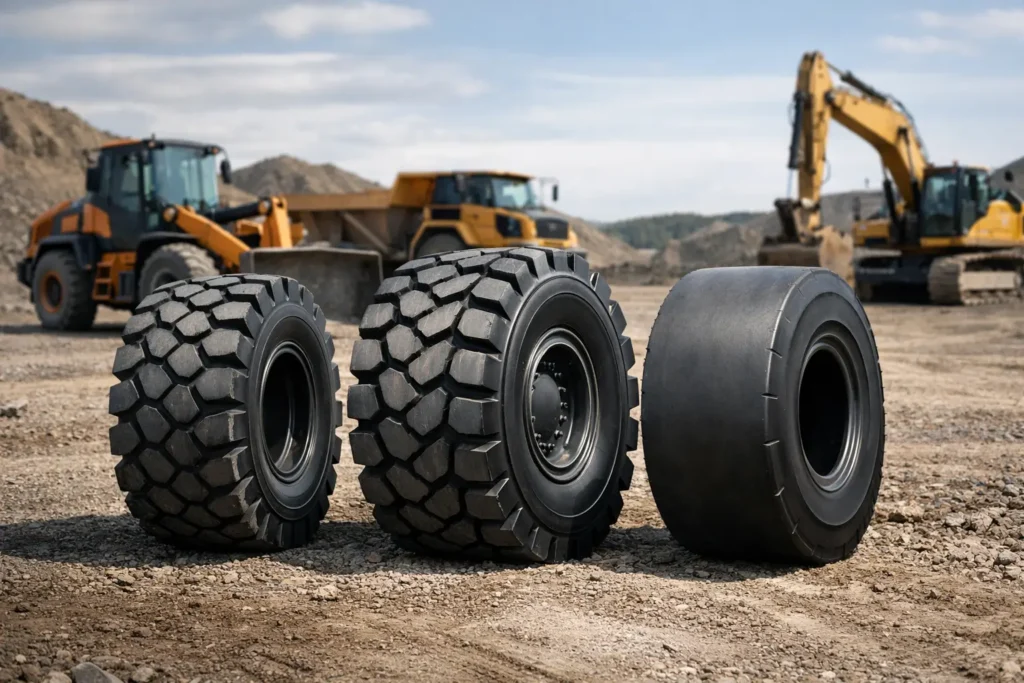
Look beyond the code to the actual tread design. Open, aggressive lugs clear mud and provide grip in soft ground, but they can wear quickly on hard surfaces. Block patterns offer stability and durability on rock. Smooth or near-smooth patterns are used in specialized port, industrial, and hard-surface applications where traction demands are lower and abrasion resistance is the priority.
Consider the Material, Heat, and Cut Risk
The ground surface is only part of the decision. The material itself can determine whether a tire survives. Sharp blasted rock, slag, scrap metal, rebar, and broken concrete call for stronger cut and chip resistance. Fine sand, clay, packed dirt, and finished aggregate may favor a tire with better flotation, traction, or heat resistance instead.
Ask how the machine is used during a normal shift. A wheel loader loading trucks at a quarry face sees different stress than the same loader handling stockpiles on flat ground. A tire that works well in a cold, wet pit may not hold up in a hot yard with abrasive concrete and frequent road travel.
For long-haul work, monitor tire heat and use the manufacturer’s ton-mile-per-hour or ton-kilometer-per-hour guidance when available. This calculation ties payload, distance, and cycle speed to a tire’s heat capability. It is especially relevant for haul trucks and scrapers. Deep tread does not automatically equal better performance when heat is the limiting factor.
New, Used, and Surplus OTR Tires
Condition can be a smart purchasing lever, particularly when sourcing large OTR sizes or outfitting a fleet. New tires provide full tread depth and known service history. New old stock can offer value, but inspect the manufacturing date, storage conditions, and sidewall condition. Tires stored indoors, away from sunlight, ozone sources, moisture, and extreme temperature swings are more likely to remain serviceable.
Used OTR tires can make sense for low-hour machines, temporary jobs, spare wheel assemblies, or equipment nearing retirement. Buy based on measurable remaining tread, casing condition, repair history, and intended use. Look closely for exposed cords, deep sidewall cuts, bead damage, irregular wear, cracking, puncture repairs, and signs of separation.
Do not judge a used tire by tread alone. A tire with usable tread but damaged sidewalls may be a poor candidate for a heavy loader or haul application. Ask for clear photos, dimensions, tread depth, DOT information when available, and a direct description of any repairs or cosmetic defects.
Plan the Purchase Around Uptime
The lowest purchase price is not always the lowest operating cost. A cheap tire that wears out early, runs hot, or fails under load can stop a crew, delay a haul schedule, and create an emergency replacement problem. On the other hand, paying for the deepest premium tread when the machine runs occasional light-duty work can tie up cash with no real return.
Buy for the duty cycle you have, not the job description printed on the machine. Keep a record of hours, loads, air pressure, road conditions, and wear patterns. That information will make the next tire decision faster and more accurate.
For hard-to-find sizes, specialized tread patterns, used assemblies, and surplus inventory, MilitaryTires.ca can be a practical source for operators, resellers, and wholesale buyers. Confirm every specification before the tire ships, then put the right rubber under the machine before the job puts it to the test.
