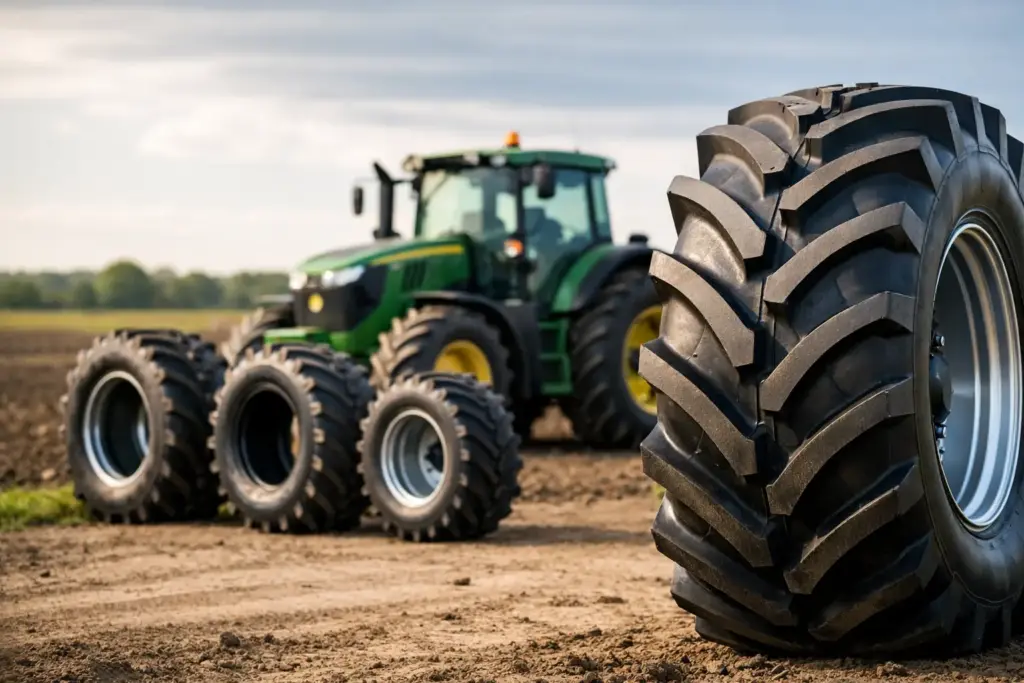
A tractor can have plenty of horsepower and still waste it at the ground. Farm tractor tires determine how effectively that power becomes pull, flotation, stability, and usable field time. The right tire protects the soil and drivetrain. The wrong one can spin excessively, pack mud into the tread, ride poorly on the road, or create a costly front-to-rear mismatch on a mechanical front-wheel-drive tractor.
Buying tires for agricultural equipment is not a matter of picking the deepest lugs or the lowest price. Start with the job, confirm the exact fitment, then compare construction, load capability, condition, and tread design. That approach matters whether you are replacing one damaged tire, fitting a loader tractor, sourcing a hard-to-find rear size, or buying a set for a fleet.
How to Choose Farm Tractor Tires by Application
The primary job should drive the tire choice. A row-crop tractor working tilled ground needs a different setup than a compact tractor spending most of its day on hard-packed yards, gravel lanes, and loader work. Field traction is only one part of the decision.
R-1 agricultural tires are the standard choice for general field work. Their angled bar tread is designed to bite into soil and clean mud from the voids as the tire rotates. They work well for tillage, planting, pulling implements, and general farm use where traction is the priority. On firm ground, however, a sharp R-1 tread can wear faster and may ride rougher than a more industrial design.
R-1W tires have deeper tread than a standard R-1. The added depth can help in wet, soft, or loose conditions, and it can extend usable tread life in demanding field work. That does not automatically make R-1W the better buy. Deeper lugs can cost more, and the right answer depends on whether the tractor actually spends enough time in difficult ground to use that extra depth.
R-2 tires are made for very wet ground and are commonly associated with rice and sugarcane applications. Their very deep tread can deliver serious traction in mud, but they are not a universal farm tire. On hard surfaces, they can wear quickly and are generally unnecessary for ordinary pasture, hay, or mixed-use work.
R-3 turf tires prioritize a broad contact patch and reduced ground disturbance. They make sense for mowing, grounds maintenance, and operations where protecting finished turf matters more than maximum drawbar pull. They are not the tire to choose for frequent muddy field work.
R-4 industrial tires sit between agricultural and turf designs. Their lugs are shallower and closer together than R-1 bars, which makes them popular on compact tractors and loader machines that see gravel, pavement, barns, construction sites, and general property work. They are durable on firm surfaces, but they do not clean mud as effectively as an R-1.
There is no tread category that wins every job. A tractor that mainly pulls equipment in cultivated soil should not be fitted with R-4 tires just because they look tougher. Likewise, a loader tractor that spends most of its time on concrete and gravel may not benefit from aggressive R-1 bars that wear rapidly and make the machine less comfortable to operate.
Reading Farm Tractor Tire Sizes and Markings
The tire sidewall provides the starting point for a correct replacement. Common agricultural sizes may appear in formats such as 18.4-38, 480/80R46, or 12.4-24. These markings identify critical dimensions, but they do not tell the entire story.
In a metric radial designation such as 480/80R46, 480 is the nominal section width in millimeters, 80 is the aspect ratio, R identifies radial construction, and 46 is the rim diameter in inches. An older designation such as 18.4-38 generally identifies nominal tire width and rim diameter, while the dash traditionally indicates bias construction. Some modern tires use equivalent sizing, but equivalent does not mean every tire has the same rolling circumference, load rating, approved rim range, or physical clearance.
Rim diameter must match exactly. A 38-inch tire requires a 38-inch rim. Width also matters. Mounting a tire on a rim outside the manufacturer-approved range can change the tread profile, reduce performance, complicate bead seating, and affect tire life. Before ordering, verify the tire size currently installed, rim width, valve type, and whether the wheel is adjustable or uses a specific disc and offset arrangement.
For front-wheel-assist and MFWD tractors, front and rear tire selection is especially critical. These machines are built around a specified lead-lag ratio between the front and rear axles. Changing only the front or rear tires, mixing brands with different rolling circumferences, or moving to a different tire series can alter that ratio. If the ratio falls outside the acceptable range, the tractor can bind in turns, wear tires quickly, and place unnecessary stress on driveline components.
Do not assume that two tires with the same sidewall size will have identical loaded rolling radius. Check manufacturer data or confirm the rolling circumference requirements for the tractor before changing tire models on an MFWD machine.
Radial or Bias Construction
Radial tires flex more through the sidewall and typically provide a longer, wider footprint. In field applications, that can improve traction, reduce slip, and spread weight over more ground. Radials can also offer a better ride and may allow lower operating pressures when the load and tire specifications permit it.
Bias-ply tires use crisscrossed casing plies and generally have stiffer sidewalls. They remain a practical choice for certain applications, especially where sidewall toughness, moderate operating speed, and initial purchase price matter most. They are common on older tractors, implement tires, and equipment working in brush, rough yards, or situations where sidewall damage is a regular concern.
The trade-off is straightforward. Radials often deliver better field efficiency and ride quality, while bias tires can be economical and durable for the right service. Neither construction should be selected on price alone. Match it to the tractor, the load, the terrain, and the hours the machine will work each season.
Load Rating, Inflation Pressure, and Ballast
A tire carries weight through air pressure, not through the rubber alone. That is why load rating and inflation pressure must be treated as a pair. A tire can be physically mounted on the tractor and still be wrong for the work if it is operated below the pressure needed for the actual axle load.
Loader work changes the equation quickly. A front tire that performs adequately while mowing may be overloaded when the bucket is raised with wet soil, feed, stone, or pallets. Rear implements, mounted tanks, bale spears, and heavy three-point equipment also change axle loads. Check the tire manufacturer load-and-inflation table for the exact size, construction, speed, and duty cycle.
Underinflation can cause excessive sidewall flex, heat buildup, bead issues, and casing damage. Overinflation reduces the footprint, can increase compaction, and often makes the tractor ride harder. The best pressure is not a fixed number copied from another tractor. It is the pressure that supports the measured or estimated axle load within the tire’s published limits.
Ballast deserves the same attention. Liquid ballast, wheel weights, and cast centers can improve traction and stability, but they also increase the load each tire carries. If calcium chloride has been used, inspect wheels carefully for corrosion around the valve stem, bead area, and rim seams. A good tire mounted on a compromised wheel is not a complete repair.
Buying Used or Surplus Agricultural Tires
Used and new old stock inventory can be a practical way to source farm tires, particularly in uncommon sizes or for equipment that does not justify the cost of a new premium set. The key is evaluating condition as closely as you would evaluate the size.
Look beyond remaining tread. Check for sidewall cracking, weather checking, exposed cords, bead damage, prior repairs, uneven wear, stubble damage, and signs that the tire has been run flat. For rear tractor tires, measure lug depth in several locations. A tire can look strong from one side and have substantially more wear on the inside shoulder or across the center bars.
New old stock can offer unused tread at a value price, but age and storage conditions still matter. Tires stored indoors, away from direct sunlight, ozone sources, and moisture are generally preferable to inventory that has spent years exposed to the elements. Confirm the DOT date code where applicable and inspect the casing before mounting.
For matched axle pairs, aim for similar brand, model, size, construction, and tread depth. This is particularly important on driven axles and essential on MFWD tractors. One low-cost mismatched tire can create more expense through poor traction, accelerated wear, or drivetrain problems than it saves at purchase.
A Practical Fitment Check Before Ordering
Before committing to a tire, have the information that prevents most ordering mistakes: the complete sidewall size, rim diameter and width, tire construction, load requirement, tread type, current rolling circumference when relevant, and the tractor’s primary use. If replacing only one tire, record the make, model, and measured tread depth of the tire remaining on the same axle.
Also account for physical clearance. Wider tires may interfere with fenders, steering components, crop-row spacing, dual hardware, or mounted implements. Taller tires can change ground speed and clearance, which may be useful in some applications but can also affect gearing and fitment.
MilitaryTires.ca carries specialized surplus, agricultural, industrial, and off-road tire inventory for buyers who need specific sizes, conditions, and value-focused options. Inventory changes, so a buyer who has the full fitment details ready is in the best position to move when the right tire becomes available.
A tire purchase should solve the work problem in front of you, not create a new one at the axle. Confirm the specifications, inspect the condition, and choose the tread and construction that match where the tractor actually earns its keep.


 Hutchinson Beadlock 20″x10″ for Tubeless set up
3 × $55.00
Hutchinson Beadlock 20″x10″ for Tubeless set up
3 × $55.00 
 7.00-6 BFGoodrich aircraft tire on wheel
1 × $415.00
7.00-6 BFGoodrich aircraft tire on wheel
1 × $415.00  14.00R20 Michelin XL
1 × $400.00
14.00R20 Michelin XL
1 × $400.00  20x10 Beadlock 10 bolt Wheels/ 4000 axle series
1 × $340.00
20x10 Beadlock 10 bolt Wheels/ 4000 axle series
1 × $340.00  37X12.50R16.5LT Goodyear Wrangler Enforcer MT
1 × $350.00
37X12.50R16.5LT Goodyear Wrangler Enforcer MT
1 × $350.00  20x10 Titan Beadlock Wheel
3 × $275.00
20x10 Titan Beadlock Wheel
3 × $275.00  20x10 Titan 5-Ton Wheel
1 × $125.00
20x10 Titan 5-Ton Wheel
1 × $125.00  24 bolt Beadlock 16.5" x 8.25" HMMWV H1
2 × $115.00
24 bolt Beadlock 16.5" x 8.25" HMMWV H1
2 × $115.00  14.00-20 General
1 × $425.00
14.00-20 General
1 × $425.00