

Uncategorized
Best Farm Tire Tread Patterns for Working Ground
Oct
A tractor can have the right horsepower and still lose the job at the tire. The best farm tire tread patterns are not simply the deepest lugs available. They are the patterns that put power to the ground without burying the machine, tearing up the field, or wearing out too quickly on pavement.
For agricultural buyers, tread selection starts with the work, the soil, and the amount of road travel between jobs. A tire that performs well in soft cultivated ground may be the wrong choice for a loader tractor on packed yards. A deep field tire may give up ride quality and tread life when the machine spends most of its time pulling wagons on the road.
R-1: The Standard Field Traction Pattern
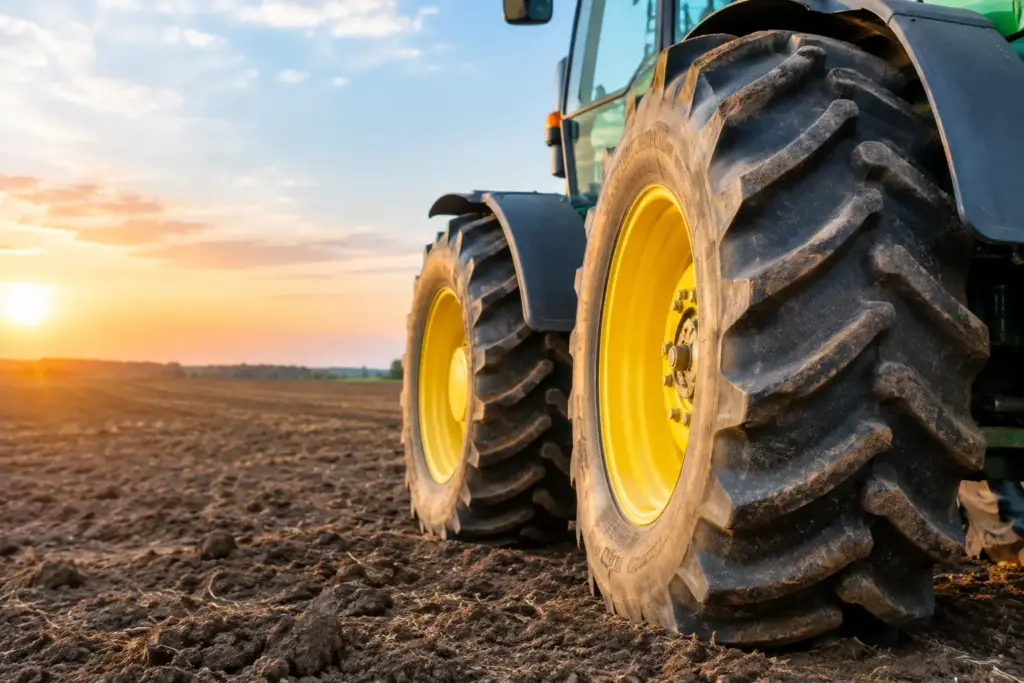
R-1 is the familiar agricultural bar-lug tread found on many rear tractor tires. Its angled, open lugs are designed to bite into loose and moderately firm soil, clear dirt as the tire rotates, and provide reliable forward pull during tillage, planting, mowing, and general field work.
For many row-crop and mixed-use tractors, R-1 remains the practical baseline. The lug spacing sheds soil well, which matters when ground conditions turn damp. It also provides strong traction without the extreme lug depth of a specialty wet-ground tire.
The trade-off is road performance. R-1 lugs can wear faster on pavement than more road-oriented patterns, especially with frequent high-speed travel, heavy loads, or incorrect inflation. They also tend to ride rougher than turf or industrial designs. If the tractor is primarily a field machine, those compromises are usually acceptable. If it is a yard, loader, and road machine first, look harder at R-4.
R-1W: Deeper Lugs for Wet Ground
An R-1W tire uses a similar bar-lug layout to R-1, but with deeper tread. The “W” commonly refers to wet conditions. More lug depth gives the tire additional clearance and more material to work with in mud, soft clay, manure-packed areas, and saturated fields.
R-1W is often the better choice where spring work regularly happens before fields are fully dry, or where the tractor has enough power and weight to take advantage of the deeper bars. It can maintain traction longer as conditions worsen, particularly on heavier soils where shallow lugs fill quickly.
Deeper is not automatically better. R-1W tires may cost more, ride more aggressively on hard surfaces, and wear faster if the machine sees substantial pavement use. They can also leave a stronger footprint when spinning, so operators still need to manage ballast, tire pressure, and throttle. A deep-lug tire will not protect soil if it is run overloaded or allowed to slip excessively.
R-2: Specialty Tread for Mud and Rice Fields
R-2 tread patterns are built for severe mud. They have very deep, widely spaced lugs intended to keep working where conventional agricultural tires pack solid. Rice fields, flooded ground, drainage work, and extremely soft conditions are where this design earns its place.
For normal hay, crop, and general farm work, R-2 is usually more tire than necessary. The aggressive tread can be hard on roads, rough on firm ground, and less economical for a machine that only occasionally encounters mud. But when a tractor must operate in wet soil as part of its regular workload, an R-2 pattern can prevent the downtime and recovery costs that come with getting stuck.
This is a fit-for-purpose tire. Buy it for consistently severe conditions, not for the idea that the biggest lug is always the best lug.
R-4: Industrial Tread for Loaders and Hard Surfaces
R-4 tires are common on compact and utility tractors with front-end loaders, backhoes, forks, and frequent hard-surface use. Their lugs are generally wider, closer together, and less aggressive than R-1 bars. The construction is often aimed at durability in gravel, packed yards, construction areas, and mixed industrial work.
The main advantage is resistance to chunking and wear on abrasive surfaces. An R-4 can be a sound choice for a farm tractor that spends more time moving pallets, feeding livestock, maintaining lanes, loading material, or working around a shop than pulling field implements.
The limitation is clear in loose soil and mud. An R-4 normally will not match R-1 traction in cultivated ground. Its tighter pattern can load up with mud, and its shorter lugs do not reach as far into soft soil. Operators who need dependable field traction should not choose R-4 solely because it looks tougher. Its strength is hard-surface utility, not maximum drawbar pull.
Rib Treads for Front Axles and Implements
Not every farm tire needs a bar-lug pattern. Rib tread tires, including common F-1 and F-2 styles, are used on non-driven front tractor axles, wagons, planters, and implements. Their longitudinal ribs provide steering control, lower rolling resistance, and predictable tracking in worked ground.
A three-rib front tire is a familiar choice for two-wheel-drive tractors because it cuts through loose topsoil and helps the tractor hold a straight line. A multi-rib tire spreads load and can improve stability for heavier applications. The right option depends on axle load, terrain, and whether the tire needs to steer in furrows, carry implement weight, or travel frequently on roads.
Using a rib tire where a driven lug tire belongs is an obvious mistake. Less obvious is fitting an overly aggressive tire to a light steering axle. Excessive tread can increase steering effort, disturb soil, and offer little benefit when the axle is not delivering power.
Choosing Among the Best Farm Tire Tread Patterns
Start with the work that actually puts hours on the machine. A tractor used 70 percent in fields and 30 percent on gravel roads needs a different compromise than one used 70 percent with a loader and 30 percent mowing or pulling light implements.
Soil type matters just as much. Sandy soil may not require extreme lug depth, while clay can turn into a traction problem after one wet day. Hilly ground raises the need for consistent grip and lateral stability. Heavy draft work calls for a pattern that can transfer torque without excessive wheel slip. For a compact tractor working around buildings and finished ground, turf protection and surface wear may matter more than raw traction.
Also consider the machine’s drive configuration. Four-wheel-drive and mechanical front-wheel-drive tractors need compatible rolling circumference between front and rear tires. Changing tire type, size, or brand without checking the manufacturer’s lead-lag requirements can create driveline stress. A tread decision is never separate from fitment.
Radial or Bias Construction Changes the Result
Tread pattern gets most of the attention, but construction affects how that pattern works. Radial agricultural tires generally provide a longer, wider footprint at appropriate pressures. That can improve traction, reduce compaction, and support better ride quality. They are a strong option for higher-acreage work and operators managing soil pressure closely.
Bias-ply tires use stiffer sidewalls and are often favored where sidewall toughness, lower acquisition cost, or intermittent use takes priority. They can be a practical fit for older equipment, wagons, implements, and hard-use applications where flexibility is less important than durability.
Neither construction wins every job. A radial R-1 may be the right working tire for a field tractor, while a bias industrial tire may make more sense for a machine exposed to debris, sharp material, and loader work. Match the tire to the operating conditions instead of treating radial or bias as a universal upgrade.
Check the Whole Tire Before Buying Surplus or Used Inventory
Specialty agricultural sizes can be difficult to source, which is why surplus, new old stock, and used tires can offer real value. The price only works, however, when the tire’s condition matches the job.
Check remaining tread depth and look for uneven wear that may point to alignment, inflation, or mechanical issues. Inspect sidewalls for weather checking, exposed cords, cuts, repairs, and bead damage. Verify the size, ply rating or load index, overall diameter, and rim compatibility. On paired rear tires, confirm that both tires are close enough in rolling circumference and condition to work together properly.
For older stock, inspect the date code and storage condition. A tire stored indoors and protected from sunlight can be very different from one that has spent years outdoors. Buyers looking for hard-to-find farm, industrial, or military-spec inventory can use sources such as MilitaryTires.ca to compare available sizes and condition notes, but fitment and application should still be confirmed before purchase.
Make Traction a Measured Decision
The right tread should let the machine work with controlled slip, not constant spin. If a tractor is spinning heavily, adding more throttle usually wastes fuel, damages the field, and shortens tire life. Correct ballast and inflation often improve performance as much as a more aggressive tread pattern.
Before replacing tires, measure the rims, confirm the required load capacity, and write down where the machine spends its hours. That short check will point most buyers toward R-1 for standard field work, R-1W or R-2 for regular wet-ground work, R-4 for loader and hard-surface duty, or rib tires for steering and implement applications. Choose the pattern that fits the ground you work tomorrow, not the one that only looks toughest in the yard.
