

Uncategorized
Runflat Versus Pneumatic Tires for Hard Use
Nov
A tire failure on a paved commuter route is an inconvenience. A tire failure on a haul road, remote farm, jobsite, trail, or tactical vehicle can stop an operation. That is the real question behind runflat versus pneumatic tires: how much mobility do you need after a loss of air, and what are you willing to trade to get it?
The terminology needs one quick correction. Most runflat systems are still pneumatic tires. They hold air and operate normally when inflated. What buyers usually mean by this comparison is a runflat-capable tire or tire-and-wheel system versus a conventional pneumatic tire with no runflat support. The right choice depends on vehicle weight, operating surface, available service, wheel design, load requirements, and the cost of downtime.
Runflat Versus Pneumatic Tires: The Basic Difference
A conventional pneumatic tire carries the vehicle on compressed air. Its casing, sidewalls, belts, and tread are designed to work at a specified inflation pressure. When pressure is lost, the tire can no longer support its intended load. Continuing to drive may destroy the casing, damage the wheel, and create a safety issue.
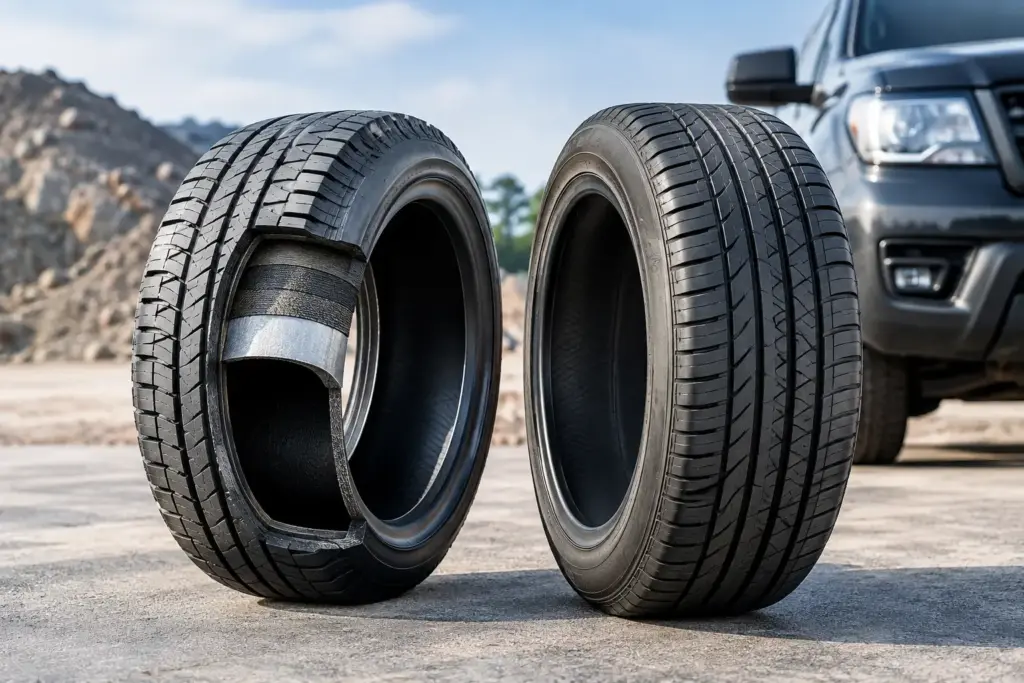
A runflat system is built to provide limited mobility after pressure loss. There are several ways it does this. Passenger and light-truck runflat tires commonly use reinforced sidewalls that can temporarily support the vehicle after deflation. Military, commercial, and off-road applications may use internal support rings, beadlock-compatible wheels, or runflat inserts that carry the tire and wheel when the air chamber is no longer doing the work.
That distinction matters. A sidewall-supported runflat from a consumer vehicle is not the same product as a military wheel assembly with a Hutchinson-style internal runflat insert. The latter is intended for severe-duty applications, but it also requires matched components and correct installation.
When a Conventional Pneumatic Tire Is the Better Buy
For many working vehicles, a standard pneumatic tire remains the most practical answer. It generally delivers a better ride, lower replacement cost, broader size availability, and simpler service. If a truck, trailer, loader, tractor, or off-road rig operates near a shop, carries a spare, or has roadside support available, conventional tires can provide the best operating value.
Pneumatic tires also offer more flexibility in how they are used. Inflation pressure can be adjusted within the manufacturer’s limits for load and terrain. On soft ground, sand, snow, or rough trails, reducing pressure may increase the contact patch and improve flotation. On the road, restoring correct pressure helps control heat buildup, handling, and tread wear.
For agricultural, industrial, and commercial applications, tire selection is often driven by load rating, ply rating, tread pattern, speed, rolling resistance, and casing condition. A runflat feature does not replace those basics. A tire that survives a puncture but is undersized for the axle load is still the wrong tire.
Standard pneumatic tires are also easier to repair or replace in most markets. A common commercial truck size or agricultural tire can often be serviced locally. Specialized runflat assemblies may require a shop with the proper equipment, trained technicians, and access to replacement inserts or compatible wheel hardware.
Where Runflat Systems Earn Their Cost
Runflats make sense when loss of mobility creates a larger problem than the added purchase price, weight, and service complexity. That includes security vehicles, military vehicle restorations, remote utility fleets, certain emergency-response units, and off-road equipment that cannot be safely recovered where it operates.
The major benefit is not unlimited travel. It is controlled movement after a puncture or pressure loss. A runflat system can allow a vehicle to clear an exposed area, reach a service point, return to base, or avoid being stranded on difficult terrain. That capability can protect equipment, reduce recovery costs, and keep a mission or job moving.
For military-spec wheels and tires, the runflat component may be part of the original assembly design. A surplus tire alone does not automatically provide runflat capability. Buyers need to confirm whether the wheel contains an insert, whether the insert is serviceable, and whether the tire, wheel, locking ring, and valve configuration are intended to work together.
Runflat capability is especially relevant for vehicles with limited spare-tire capacity. Some heavy rigs and specialized platforms use large, uncommon sizes where carrying a complete spare assembly is difficult. In that case, limited post-puncture mobility may be more useful than relying on a roadside change that requires lifting equipment and specialized tools.
The Trade-Offs: Weight, Ride, Heat, and Service
Runflat systems are not free insurance. Reinforced sidewalls and internal support devices add weight. Extra unsprung weight can affect ride quality, steering response, suspension wear, and fuel consumption. On a heavy platform, that may be an acceptable compromise. On a lighter truck used mainly on pavement, it may be unnecessary expense.
Ride quality can also be firmer. A reinforced sidewall does not flex like a conventional casing, and an internal support system changes how the tire behaves when it encounters impacts. For vehicles that spend long hours on paved roads, the difference can be noticeable.
Heat is another concern. A tire operated after air loss generates substantial heat, even with runflat support. The allowable distance and speed after deflation are not universal. They depend on the tire or insert design, vehicle load, ambient temperature, road surface, and manufacturer guidance. A runflat system is intended to get the vehicle out of trouble, not to be treated as a normal operating mode.
Installation and dismounting are more involved as well. Multi-piece military wheels, beadlock systems, internal inserts, and locking hardware require trained handling. These are not casual tire-shop assemblies. Incorrect mounting can damage components or create serious safety hazards during inflation and operation.
Fitment Matters More Than the Label
Before buying a runflat-capable assembly, start with the wheel. Confirm diameter, width, bolt pattern, center bore, offset or backspacing, and brake clearance. For split-rim or multi-piece wheels, verify the complete component set and match all parts correctly. Do not mix rings, flanges, inserts, or hardware from different wheel systems unless the manufacturer specifically approves it.
Then verify the tire. The size must match the wheel, but that is only the first step. Check load index or ply rating, maximum inflation pressure, overall diameter, section width, tread type, and speed rating. On dual-wheel applications, matched outside diameter is critical. On four-wheel-drive vehicles, major differences in rolling circumference can stress driveline components.
Condition is equally important in surplus inventory. New old stock may have full tread but still requires inspection for age, storage conditions, sidewall cracking, bead condition, and casing integrity. Used takeoffs should be checked for repairs, uneven wear, cuts, weathering, and signs of prior underinflation. With runflat assemblies, inspect the insert, wheel condition, valve hardware, and any bead-retention components as carefully as the tire itself.
Cost Should Be Measured Against Downtime
A standard tire usually wins on initial cost. It is simpler to source, mount, repair, and replace. For an operator with spares, service access, and predictable routes, that can be the clear commercial choice.
A runflat assembly costs more because it is a system, not just a tire. The total includes specialized wheels or inserts, mounting labor, possible sensors, and more complicated replacement planning. But the lowest purchase price is not always the lowest operating cost. One remote recovery, missed shift, delayed delivery, or disabled vehicle in unsafe terrain can outweigh the savings from a conventional setup.
This is why runflat decisions should be made at the fleet or equipment level, not just at the tire rack. Consider the vehicle’s mission, the probability of puncture, the cost of a stop, the availability of recovery equipment, and the skill level of the people who will service it.
Choose for the Failure You Can Actually Manage
If your equipment works close to support and needs the best ride, broadest tire selection, and straightforward repair options, conventional pneumatic tires are usually the right call. If the vehicle must retain limited mobility after a pressure loss and operates where recovery is expensive, slow, or unsafe, a properly matched runflat system can justify its added complexity.
The practical move is to buy the complete solution that fits the wheel, axle load, terrain, and service plan. A hard-to-find military tire or wheel assembly is only valuable when every component works together and the vehicle can be maintained properly after it leaves the yard.
