

Uncategorized
Industrial Forklift Tire Guide for Working Fleets
Oct
A forklift can have a sound mast, strong hydraulics, and a capable operator, then lose productivity because the tires do not match the floor, load, or duty cycle. This industrial forklift tire guide is built for buyers who need working equipment, not generic tire advice. Whether the truck runs smooth concrete indoors, broken asphalt outside, gravel yards, or a mix of all three, tire selection affects stability, ride quality, traction, downtime, and operating cost.
The right tire is not always the lowest-priced tire, and it is not always the most aggressive tread. Start with the forklift’s approved tire size, rim type, axle position, load requirements, and actual work surface. Then compare condition and construction against the hours the machine will work.
Start With the Forklift, Not the Tire
Forklift tires are part of the machine’s rated operating system. A change in outside diameter, section width, tire construction, or rim fit can alter ground clearance, stability, turning behavior, and capacity performance. Do not assume a tire that physically mounts is an acceptable replacement.
Check the tire placard, operator’s manual, or existing tire markings before ordering. Record the full size, including the rim diameter, as well as whether the tire is pneumatic, solid pneumatic, cushion, or press-on. On used equipment, verify that the current tires are actually correct. Machines are often bought at auction or from service fleets with mixed tire sets already installed.
The forklift’s data plate matters just as much as the tire sidewall. Capacity ratings are based on specific configurations. A different tire type can change the truck’s overall geometry and dynamic stability. For heavy lifts, high stacking, uneven ground, or long travel distances, stay within the manufacturer’s approved tire specifications and consult a qualified forklift technician when there is any doubt.
Industrial Forklift Tire Guide: Know the Main Types
Cushion tires
Cushion tires are solid rubber tires pressed onto a steel band or mounted as a resilient assembly, depending on the design. They are common on electric and internal-combustion forklifts working indoors on smooth, level concrete. Their compact profile allows tight turning and lower overhead clearance, which makes them a practical choice for warehouses, loading docks, and production floors.
The trade-off is limited shock absorption and poor performance on rough ground. Cushion tires can wear quickly on broken pavement, sharp debris, and extended outdoor runs. They are not built for gravel yards or construction-type terrain. If the forklift regularly leaves the building, a pneumatic setup may be the better fit.
Pneumatic tires
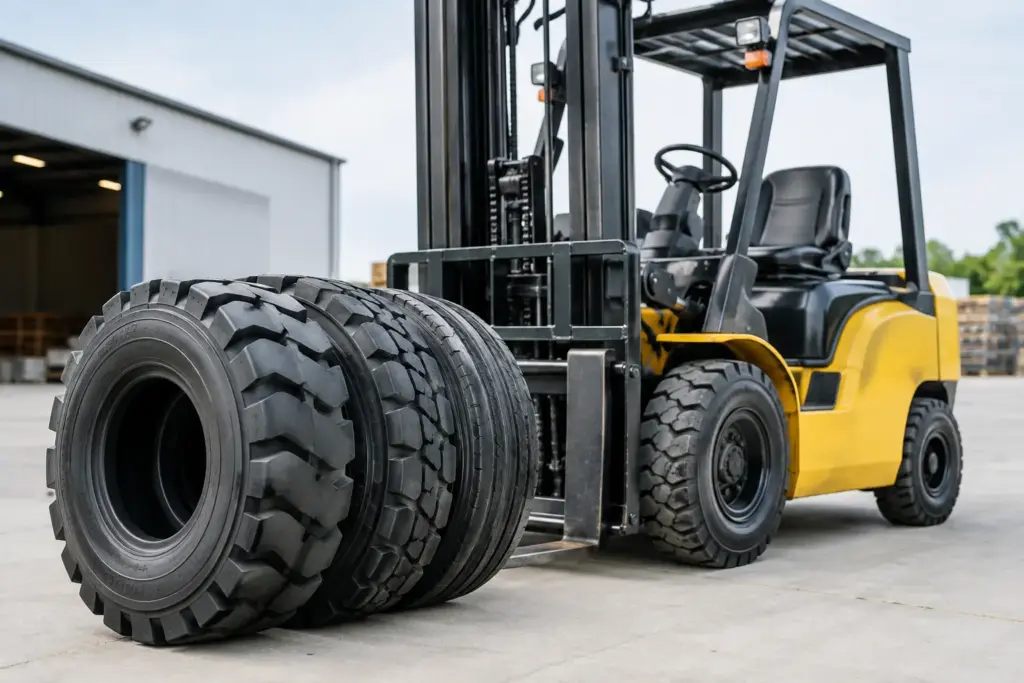
Pneumatic forklift tires use an air-filled casing, similar in concept to a truck or off-road tire. They provide better cushioning, traction, and obstacle performance than cushion tires. They are commonly used on outdoor forklifts, lumber yards, farms, industrial sites, ports, and mixed-surface operations.
Air-filled tires ride better over potholes, joints, gravel, and uneven pavement, but they can puncture. That is the main operating trade-off. A tire that improves ride and traction may also create downtime if the jobsite has scrap metal, sharp stone, demolition debris, or frequent curb contact.
Solid pneumatic tires
Solid pneumatic tires have the profile and fitment of pneumatic tires but use solid rubber rather than an air chamber. They are a strong option where punctures are expensive, frequent, or unacceptable. Recycling yards, metal handling operations, scrap facilities, demolition work, and rough industrial sites often benefit from solid pneumatic construction.
They generally cost more upfront and transmit more vibration than air-filled tires. They can also add weight and may affect ride quality over long outdoor travel routes. For a forklift that spends most of its day on smooth pavement, the additional cost and stiffness may not pay back. For a truck repeatedly sidelined by flats, they often do.
Press-on band tires
Press-on band tires are commonly used on smaller electric forklifts, pallet equipment, and narrow-aisle machines. The rubber tire is bonded or fitted to a steel band and pressed onto the wheel hub. They provide a compact, stable solution for hard indoor surfaces where space is limited.
Replacement requires the correct shop equipment. A press-on tire is not a field-service item in the same way as a conventional pneumatic wheel and tire assembly. Confirm the band diameter, tire dimensions, and wheel compatibility before purchasing.
Match Tread to the Ground You Actually Cover
Tread is a working feature, not decoration. Smooth or low-profile industrial tread typically gives a larger contact patch and predictable wear on clean concrete. It is common in warehouse service where rolling resistance, stability, and floor protection matter more than loose-surface traction.
Lug or traction tread is better suited to dirt, gravel, mud, snow, and broken surfaces. It helps the drive axle bite into loose material, but it may wear faster on polished concrete and can feel less refined indoors. Deep tread also does not solve every traction problem. Oil, water, dust, loose shrink wrap, and uneven loading practices can create wheelspin regardless of pattern.
For mixed indoor-outdoor fleets, the decision comes down to which environment causes the most lost time. A warehouse forklift that occasionally crosses a paved yard does not necessarily need an aggressive outdoor tire. A yard truck that enters a warehouse for brief loading runs should not be limited by smooth indoor tires that lose grip outside.
Read Tire Sizes and Rim Requirements Carefully
Industrial forklift tire sizing can appear in several formats. A size such as 7.00-12 generally identifies a tire intended for a 12-inch rim, while a format such as 28 x 9-15 identifies approximate overall diameter, section width, and rim diameter. Metric sizes may also appear, particularly on imported equipment and specialty applications.
Do not order from one number alone. Compare the complete marking and confirm the wheel style. Split-rim, multi-piece, and specialty industrial wheel assemblies require correct components and trained service procedures. Improper handling of multi-piece wheels can cause serious injury.
Also inspect the rim itself. Rust around bead seats, bent flanges, cracked welds, damaged lock rings, and worn mounting surfaces can ruin a replacement tire or create a safety problem. When buying takeoff tires or surplus inventory, ask for the tire size, condition, tread depth where relevant, and whether wheels are included. A tire-only price is not the same as a ready-to-install wheel and tire assembly.
Load, Stability, and Wear: The Costs That Matter
Forklift tires carry more than the listed load. They absorb turning forces, braking loads, impacts, side loading, and the repeated stress of operating with a raised mast. Overloading, hard cornering, curb strikes, and driving with low pneumatic pressure all shorten tire life.
For pneumatic tires, maintain pressure according to the forklift manufacturer’s specification. Underinflation creates excess heat, unstable handling, sidewall damage, and premature wear. Overinflation reduces contact area and makes the truck ride harder. Check pressure when the tires are cold and inspect for cuts, bead damage, embedded debris, and uneven tread wear.
On solid and cushion tires, watch for chunking, cracking, separation, flat spots, and wear down to the manufacturer’s wear indicators. A tire may still have rubber remaining but be unsuitable if the wear line, safety groove, or sidewall condition shows it has reached the end of service. Replace matched tires as needed on the same axle to avoid uneven traction and handling.
Uneven wear is useful evidence. Center wear on a pneumatic tire can point to overinflation. Shoulder wear often suggests underinflation or heavy cornering. One-sided wear may indicate alignment issues, worn steering components, a bent wheel, or a repeated travel pattern that favors one direction. Replacing tires without correcting the cause wastes money.
New, Used, and Surplus Forklift Tires
New tires offer predictable condition and full usable tread, but they are not the only sensible purchase for every machine. New old stock can provide a cost-effective option when the tire has been stored correctly and inspected for age-related cracking, hardening, or casing damage. Surplus inventory can also be valuable when a discontinued size or specialty industrial fitment is difficult to source through standard channels.
Used forklift tires can make sense for lower-hour equipment, resale preparation, temporary replacements, or older machines where budget control matters. Condition must be evaluated honestly. Check remaining tread or rubber depth, sidewall cuts, repairs, chunking, weather checking, bead condition, and whether the tire has worn unevenly. A cheap used tire becomes expensive if it fails early or causes the forklift to sit.
For fleet buyers and resellers, availability can be as important as unit price. Buying compatible pairs or full sets when uncommon sizes are available can reduce future downtime. Keep fitment records by forklift model and serial number, especially when operating mixed fleets.
A Practical Buying Check Before You Order
Before committing to a forklift tire, verify these four points: the exact tire size and rim configuration, the forklift’s approved tire type, the work surface and debris exposure, and the tire’s condition if buying used or surplus. Then compare the cost of the tire against the cost of a flat, a service call, a stalled loading schedule, or a machine operating with poor traction.
A forklift tire is a working component with a direct effect on safety and output. Buy the construction that fits the job, inspect it before it becomes a failure, and keep the correct replacement size on hand when the operation cannot afford to wait.
