

Uncategorized
Commercial Truck Rim Guide for Working Fleets
Nov
A rim that is close is not a rim that fits. On commercial trucks, the wrong wheel can create clearance problems, mounting failures, premature tire wear, or a load-capacity issue that only shows up when the truck is working. This commercial truck rim guide covers the measurements and condition checks that matter before buying rims for a highway truck, vocational unit, trailer, off-road application, or specialty fleet.
For many buyers, the challenge is not finding a wheel with the right diameter. It is confirming every part of the fitment: bolt pattern, pilot type, offset, width, load rating, brake clearance, and tire compatibility. That is especially true when purchasing used takeoffs, surplus inventory, or hard-to-find military and industrial wheel assemblies.
Commercial Truck Rim Guide: Start With the Application
Start with the vehicle’s actual job, not just its existing rim size. A regional highway tractor, dump truck, lowboy trailer, airport support vehicle, and agricultural conversion may all use commercial-style wheels, but their priorities are different. A highway fleet may prioritize weight, fuel economy, and easy replacement. A severe-service truck may need steel construction, higher impact resistance, and a wheel that can take repeated abuse on rough ground.
Check the axle rating and the load carried by each wheel position. A wheel’s load rating must meet or exceed the requirement at that position. Do not assume a rim is suitable because it came off a similar-looking truck. Tire load capacity, inflation pressure, wheel rating, and axle rating work as a system. The lowest-rated component limits the assembly.
Also consider whether the wheel will run as a single or dual. A rim approved for a steer position may not meet the requirements for a heavily loaded drive axle. Dual spacing matters as well. Incorrect offset or wheel design can reduce the gap between dual tires, trapping stones, increasing heat, and causing sidewall contact under load.
Read the Rim Specifications Before You Buy
Commercial rims are commonly identified by a size such as 22.5 x 8.25 or 24.5 x 8.25. The first number is the bead-seat diameter, while the second is rim width. Those numbers are essential, but they do not tell the full fitment story.
Diameter and width
A 22.5-inch tubeless commercial wheel does not accept every 22.5-inch tire in every width. Match the tire manufacturer’s approved rim-width range to the wheel. Mounting a tire on a rim that is too narrow or too wide changes the tread profile and can affect handling, wear, heat buildup, and casing life.
A common example is moving from a standard 11R22.5 setup to a wider 315/80R22.5 tire. The tire may fit the diameter, but it may require a different rim width and could create clearance issues at the fender, suspension, frame, or adjacent dual tire. Verify the full tire section width, not only the size printed on the sidewall.
Bolt pattern and pilot type
Most modern North American commercial trucks use hub-piloted wheels, often referred to as stud-piloted versus hub-piloted systems depending on the application and age of the equipment. These are not interchangeable by guesswork.
Hub-piloted wheels center on the hub bore and typically use flange nuts. Stud-piloted wheels center on the studs and commonly use inner and outer nuts on dual assemblies. The wheel’s bolt circle, number of bolt holes, stud diameter, and center bore must match the hub. A wheel may have ten holes and still be wrong for the truck.
Measure the bolt circle accurately if the wheel markings are unavailable. For fleet purchases, record the wheel part number and hub information from an existing confirmed fitment. That is faster and more reliable than relying on a photo or a general vehicle description.
Offset, inset, and backspacing
Wheel offset controls where the rim sits in relation to the hub. This affects steering clearance, brake clearance, track width, dual spacing, and how far the tire extends beyond the body. A small difference can become a major issue on trucks with wide tires, tire chains, suspension modifications, or tight fenders.
On dual-wheel applications, use the correct inner and outer wheel arrangement. Do not mix wheel types simply because they bolt on. The assembly must maintain proper spacing and run true under load.
Steel vs. Aluminum Commercial Wheels
Steel and aluminum each have a place in a working fleet. The right choice depends on route, load, budget, maintenance practices, and the availability of matching replacements.
Steel wheels are typically the practical choice for vocational trucks, trailers, construction equipment, and applications where impact damage is more likely. They are generally less expensive upfront and easier to source in many common configurations. Their trade-off is weight and the potential for corrosion, especially where trucks see road salt, moisture, or long periods of storage.
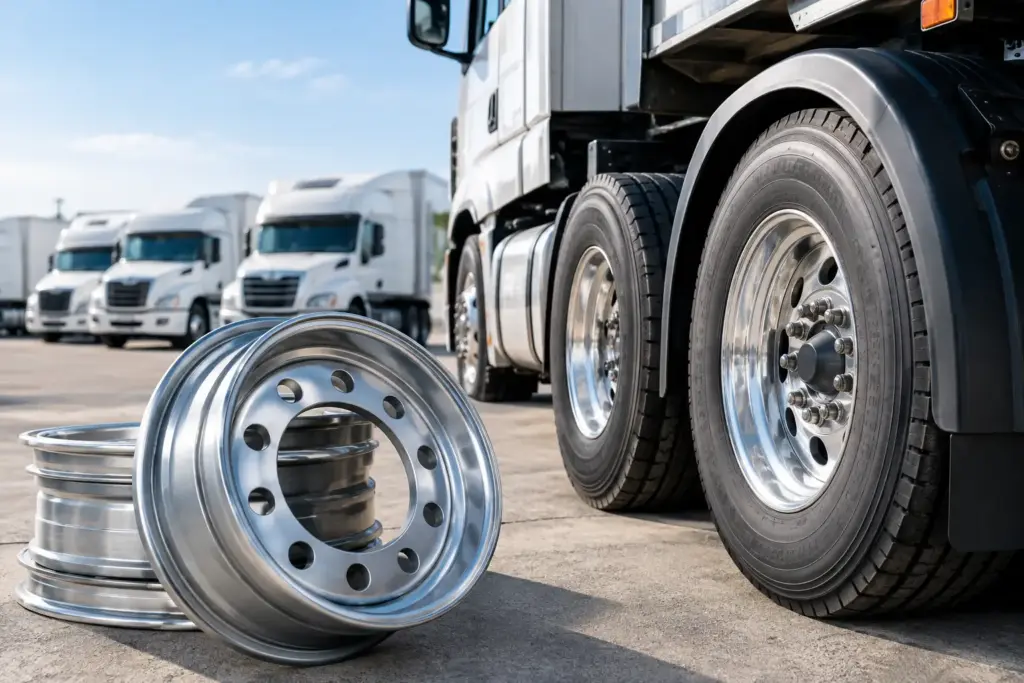
Aluminum wheels reduce unsprung weight and are common on line-haul tractors and appearance-focused fleets. They can help reduce weight across a full truck-and-trailer combination, but they require inspection for cracks, corrosion around mounting surfaces, and damage from curbing or improper handling. Polished aluminum also costs time to maintain if appearance matters.
For a mixed fleet, consistency has value. Keeping compatible wheel types and sizes in service can simplify spare inventory, tire mounting, nut torque procedures, and roadside replacement. The lowest purchase price is not always the lowest operating cost if one unusual wheel leaves a truck waiting for a replacement.
Inspecting Used, Surplus, and Takeoff Rims
Used commercial rims and takeoffs can offer real value, particularly when replacing discontinued equipment or building a budget-conscious fleet. Condition needs to be evaluated with the same discipline used for tire casings and suspension parts.
Inspect the bead seats for rust scale, pitting, gouges, and prior tire-tool damage. Damage in this area can prevent the tire from sealing correctly. Check bolt holes for elongation, cracking, or distortion. Look closely around the center disc, hand holes, welds, and mounting face, where stress damage may be harder to spot under dirt or old paint.
A wheel should also be checked for runout. Bent rims can cause vibration, irregular tire wear, and balancing problems. On aluminum wheels, do not use aggressive repair methods that remove material or hide cracking. On steel wheels, avoid assuming that fresh paint means sound metal underneath. Surface rust is one thing; deep corrosion around the bead, disc, or bolt holes is another.
New old stock can be a strong option for buyers who need unused inventory in an older or specialty specification. Still, inspect stored wheels before installation. Long storage can leave corrosion on bare steel, damage protective finishes, or result in mixed lot numbers and configurations. Confirm the markings, quantity, and condition of every wheel in a bulk purchase.
Match the Rim to Tires, Valves, and Hardware
A commercial wheel is only one part of the assembly. Confirm the tire size and approved rim range, then match the valve stem or valve hardware to the wheel and service pressure. High-pressure applications, dual setups, and specialty off-road assemblies may require specific valve configurations or extensions for proper inflation access.
Use the correct nuts, washers, and torque procedure for the wheel system. Never mix hardware from hub-piloted and stud-piloted setups. Mounting surfaces must be clean and free of heavy rust, paint buildup, grease, or debris that can affect clamping force. After installation, follow the vehicle and wheel manufacturer’s torque requirements and recheck as required by the operating procedure.
If you are buying rims for a truck conversion, military vehicle, industrial chassis, or nonstandard trailer, get measurements before ordering. Hub bore, bolt circle, wheel width, backspacing, brake dimensions, and tire clearance should be documented. A few minutes with a tape measure and caliper can prevent a costly freight return.
Buying for One Truck or a Fleet
For one replacement wheel, matching the existing wheel exactly is usually the cleanest route. Compare size, part number, pilot type, offset, material, and load rating. For a fleet purchase, build a short specification sheet before sourcing: wheel size, tire size, hub system, required rating, desired material, quantity, and acceptable condition.
Buyers sourcing specialty surplus, takeoffs, or commercial inventory should ask whether the lot is uniform. A pallet of wheels may contain mixed offsets, different center bores, or cosmetic variations that matter once they reach the shop. MilitaryTires.ca can be useful when common retail channels do not have the commercial, military, industrial, or hard-to-find wheel configuration required.
The right rim purchase is rarely about finding the cheapest wheel on the screen. Confirm the fitment, inspect the condition, and buy enough matching inventory to keep the equipment working when the next replacement is needed.
